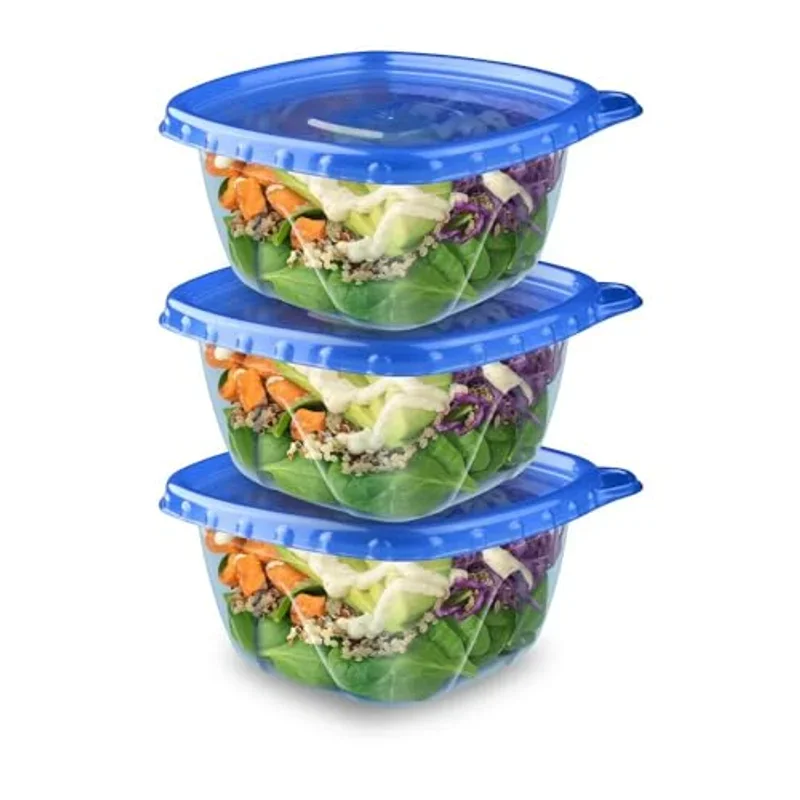
Key Specs
Container Material
BPA-free polypropylene (PP) plastic
Lid Material
BPA-free polypropylene plastic with SmartSnap Technology
Seal Type
SmartSnap one-press click-close (press-fit)
Capacity (each)
1.25 qt (40 oz / 5 cups) Deep Square
Ziploc
#8 of 8 food storage containers tested
$5.83
What the product listing won't tell you
Know before you buy
Ziploc SmartSnap containers are affordable, lightweight, and fully dishwasher-safe — but they're BPA-free polypropylene plastic with no independent safety certifications, a press-fit seal that won't reliably contain liquids, no warranty, and staining and odor absorption inherent to the material.
You need affordable, dishwasher-safe food storage and material safety is not your primary concern.
Ziploc
Ziploc Food Storage Meal Prep Containers with SmartSnap Technology (Deep Square, 3-Pack)
Ziploc
Ziploc Food Storage Meal Prep Containers with SmartSnap Technology (Deep Square, 3-Pack)
We may earn a commission. It doesn't affect our scores.
You want lightweight containers for daily lunch packing or pantry organization.
You're comfortable treating containers as semi-disposable and replacing them every few years.
The one-press SmartSnap lid matters to you — easier for kids and users with limited hand strength than 4-tab locking designs.
You're storing dry foods, leftovers, or meal prep that won't be transported as liquids in a bag.
You want to minimize chemical contact between food and plastic — microwaving PP plastic increases migration, even if it's BPA-free.
You want independent lab verification of material safety — no certifications exist for these containers.
You need reliable liquid containment in a bag — the press-fit SmartSnap is not as secure as 4-tab locking lids with gaskets.
You want a warranty and replacement lid program — Ziploc offers neither for this product.
Specs the product listing doesn't explain
What determines how well this performs its core job
What your food and family come into contact with every use
Noise, maintenance, and what happens if something goes wrong
Additional product details
8 criteria — open any layer to see exactly what we found
2
Safety
Poor
4
Efficacy
Fair
6.4
Usability
Mixed
“Will the plastic leach chemicals into my food, especially when microwaved?”
Criteria
BPA-free plastic is the industry floor, not a selling point. Polypropylene absorbs food odors, stains from tomato sauce, and can leach chemicals when microwaved. If minimizing plastic contact with food matters to you, look at glass or stainless steel options.
The lid is the same plastic as the container. No silicone gasket, no upgraded material. The SmartSnap mechanism is plastic-on-plastic.
One chemical claim: BPA-free. That's all Ziploc tells you. You have no information about BPS, phthalates, or PFAS in these containers.
R3 verdict
Ziploc containers are made of BPA-free polypropylene — the minimum acceptable claim for food-contact plastic in 2026. There are no BPS-free, phthalate-free, or PFAS-free claims anywhere.
No independent lab has tested these containers. The lid is the same polypropylene plastic, and microwaving PP plastic (even 'microwave safe') increases chemical migration into food.
This is not a brand deficiency — it's the inherent nature of polypropylene. Any PP plastic container would score similarly.
“Has anyone independently verified that these containers are safe?”
Criteria
No independent lab has tested these containers. No safety certification on the box. If you need verified safety claims, this isn't the product.
R3 verdict
No independent verification exists for these containers. No T1 PFAS lab test, no LFGB certification, no NSF listing, no Mamavation approval.
SC Johnson is a major consumer goods company with regulatory compliance obligations, but they have not published independent safety testing for this SKU. You are taking the brand's word on chemical safety.
For buyers who require independent chemical safety verification, look for containers with published lab results or LFGB certification. Pyrex (for glass) or certified glass/stainless sets offer verifiable safety.
“Will this actually keep my food fresh, and will it leak in a bag?”
Criteria
One click to close — convenient. Not leak-proof. Great for fridge and pantry. Pack liquids at your own risk.
Expect staining from pasta sauce and curry within the first few months. Food odors will transfer between uses. Normal for plastic containers.
R3 verdict
SmartSnap provides a press-fit click-close seal that scores — providing basic coverage but not truly leak-proof. It relies on friction rather than a defined locking engagement. For fridge and pantry storage it works adequately.
“Can everything go in the dishwasher, or do I need to hand-wash the lids?”
Criteria
Container and lid both go straight in the dishwasher. No hand-washing, no special care. One of the best daily-use features of these containers.
R3 verdict
Everything goes in the dishwasher — container and lid, no restrictions. This is one of the clearest practical advantages of these containers for daily family use.
No separating gaskets, no hand-washing components, no special care instructions. For busy households, this matters more than it sounds: it's the difference between using these containers every day and leaving them in a cabinet.
“What happens if the lid cracks or the seal stops working?”
Criteria
No warranty. Lid breaks, SmartSnap wears out, container stains — buy a new set. At $5.83 for 3, that's a reasonable expectation.
R3 verdict
No warranty exists for these containers. No replacement lid program.
When the SmartSnap mechanism wears out or a container stains beyond recovery, you replace the set. At $1.94/container, this is the expected trade-off.
These are priced as semi-disposable. The low upfront cost means lower long-term ownership confidence — but also lower stakes when you inevitably replace them.
“Can I use this to go from freezer to microwave, and can I reheat in the oven?”
Criteria
Microwave safe per Ziploc — but you must remove the lid first. No splatter protection while heating. For health-cautious buyers, consider glass alternatives for any microwave use.
Fully freezer safe — handles freezing without cracking. Good for meal prep batching.
“Is this light enough to carry in a lunch bag or backpack without weighing it down?”
Criteria
Lightweight plastic — easy to pack for school or work lunches. Square shape stacks efficiently in a bag. Far lighter than glass alternatives.
R3 verdict
Polypropylene plastic is a lightweight material — significantly lighter than glass or stainless steel containers of equivalent capacity. The 1.25-qt (40 oz) deep square containers are practical for daily carry: they fit in lunch bags, pack flat in a backpack, and don't add meaningful weight to a day bag. The SmartSnap seal holds for pantry and fridge transport but may not be reliable for a bag with liquids.
Good for daily carry for dry foods and semi-solids. Not recommended for liquids in a bag without testing the seal first.
“Am I getting good value for what I'm paying?”
Criteria
At $1.94 per container, this is one of the cheapest food storage options available. You're paying for convenience, not chemical safety or longevity.
R3 verdict
At $5.83 for 3 containers ($1.94 each), Ziploc SmartSnap is among the most affordable food storage options in the category. Price per R3 quality point is $0.52 — strong value per dollar at this price tier.
The trade-off is clear: the low price reflects the material choice. Polypropylene costs less than glass, stainless steel, or silicone.
The product scores below average on R3 criteria not because it's poorly made, but because the material category itself has inherent limitations.
Already have an account? Log in
Verified retailer — current pricing
Starting price
$5.83
We earn a small commission on purchases. It never influences our scores — R3 is funded by readers, not brands.
Alternatives that address specific trade-offs
Why this matters: You want independent lab verification of material safety — no certifications exist for these containers.
Stasher
Scores 6.0/10 on certification & verification vs 1.0 here

Snapware
Scores 4.0/10 on certification & verification vs 1.0 here

Glasslock
Scores 4.0/10 on certification & verification vs 1.0 here
Didn't find the food storage container you need?
See all food storage containers we reviewed#8 of 8 food storage containers reviewed
For families who want food storage containers that don't raise chemical migration concerns, glass alternatives like Pyrex Simply Store or Snapware Total Solution are the better choice. Ziploc SmartSnap is appropriate where price and convenience are the primary drivers.
For transporting liquids in a lunch bag, expect leaks. The bigger issue for preservation is the container material itself. Polypropylene is porous and will absorb tomato sauce, curry, and garlic odors after repeated use.
You'll notice this at 3-6 months of daily use.
Adequate for dry foods, leftovers, and meal prep that won't be transported. Not reliable for liquids in a bag. If long-term freshness and odor control matter, glass is the better material.
If quick daily cleanup is a priority and you're comfortable with the plastic material trade-offs, the dishwasher compatibility makes these containers easy to use consistently.
If you want containers backed by a manufacturer warranty with replacement lid availability, look at Snapware (limited lifetime on lids) or Stasher (lifetime warranty). Accept Ziploc as a budget, semi-disposable option.
Cannot go in the oven. Expected limitation for plastic. If you want to reheat casseroles or bake from frozen, you need glass containers.
R3 verdict
Freezer-to-microwave works — the container handles both freezing and microwave reheating, though the lid must be fully removed before microwaving. That covers the most common meal prep workflow, with the caveat that removing the lid eliminates splatter protection.
Freezer-to-oven is not possible with polypropylene. For families who batch-cook casseroles, soups, or grain dishes and want to reheat directly in the oven, you need glass or stainless containers.
Works for the standard meal prep cycle: cook, store, freeze, microwave to reheat (lid off). Not for oven reheating.
R3 verdict
Freezer-to-microwave works — the container handles both freezing and microwave reheating, though the lid must be fully removed before microwaving. That covers the most common meal prep workflow, with the caveat that removing the lid eliminates splatter protection.
Freezer-to-oven is not possible with polypropylene. For families who batch-cook casseroles, soups, or grain dishes and want to reheat directly in the oven, you need glass or stainless containers.
Works for the standard meal prep cycle: cook, store, freeze, microwave to reheat (lid off). Not for oven reheating.
Best choice for families on a tight budget who prioritize convenience and affordability over material safety. Accept the material limitations. Replace when needed — the cost is low.