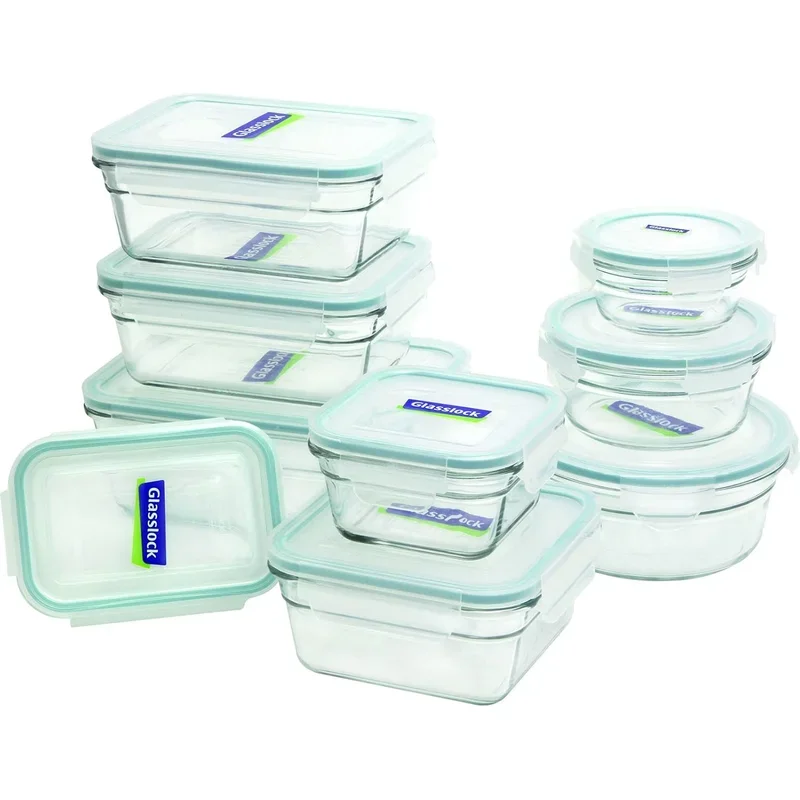
Key Specs
Container Material
Tempered soda-lime glass (TEMPERMAX)
Lid Material
BPA-free polypropylene with silicone gasket, 4 locking tabs
Oven Max Temperature
450°F
Containers in Set
9 containers
Glasslock
#2 of 8 food storage containers tested
What the product listing won't tell you
Know before you buy
The Glasslock set delivers strong value — 9 glass containers, 450°F oven-safe, lifetime warranty, replacement lids available — for under $50. The ceiling is the BPA-free plastic lid: unverified by third-party testing, not microwave or oven-safe, and the primary food-safety limitation of an otherwise strong product.
You want glass food-contact surfaces for everyday storage — no coatings, no staining, no odor absorption at any price.
Glasslock
Glasslock 18-Piece Assorted Oven Safe Container Set
Glasslock
Glasslock 18-Piece Assorted Oven Safe Container Set
$44.99
We may earn a commission. It doesn't affect our scores.
You do meal prep and need containers that go from fridge or freezer directly into a 450°F oven without switching vessels.
You want a set that will last decades — the glass containers are dishwasher-permanent, and replacement lids are available when the plastic eventually wears out.
You're upgrading from plastic storage and want glass performance without paying a glass premium — this set prices competitively with mid-tier plastic options.
You store foods that stain or smell — tomato-based sauces, curries, fish — and are tired of containers that never clean up properly.
You need to microwave with the lid on — the PP lids are not microwave-safe, and there's no venting mechanism.
You need to carry multiple containers daily — glass weight adds up quickly for commuting or school lunches.
You need third-party verified PFAS-free and plasticizer-free certification for the lid material — Glasslock has not published independent chemical testing for its PP lids.
You prefer freezer-to-oven transitions without a thaw buffer — soda-lime glass (not borosilicate) needs a temperature equalizer before going into a hot oven.
Specs the product listing doesn't explain
What determines how well this performs its core job
What your food and family come into contact with every use
Noise, maintenance, and what happens if something goes wrong
Additional product details
8 criteria — open any layer to see exactly what we found
6.2
Safety
Mixed
9.3
Efficacy
Excellent
8.5
Usability
Good
Criteria
The container body is tempered glass — no coatings, no nonstick layer, nothing to chip into your food. It won't pick up tomato sauce stains or garlic smell, ever. The one thing to watch: don't pull it from the freezer and put it directly into a hot oven — let it sit at room temperature for 10 minutes first to prevent thermal shock cracking.
The lids are BPA-free plastic with a silicone seal ring. The silicone ring is inert and safe. The plastic lid body is a food-contact surface when your container is stored on its side or stacked upside-down. It's better than unlabeled plastic, but it's still plastic — and no independent lab has checked it for BPA replacement chemicals.
Glasslock discloses BPA-free and nothing else. The glass containers don't need claims — glass doesn't have BPA, phthalates, or PFAS to begin with. For the plastic lids, one claim is the minimum. If the PP lid had BPS-free and phthalate-free claims, you'd have more confidence. Without them, the lid's chemical profile is partially unknown.
R3 verdict
The glass containers are chemically inert — tempered soda-lime glass does not leach chemicals, stain, or absorb odors regardless of what you store. Scoring 9/10 vs. borosilicate's 10/10 reflects lower thermal shock resistance only, not any food-safety difference.
Criteria
Glasslock is FDA-cleared for food contact, which is the legal minimum to sell food storage containers in the US. What's missing is an independent lab that tested them specifically for PFAS, heavy metals, and plasticizers in the plastic lids. That's the gap. Brands like Caraway and Snapware have obtained those certifications — Glasslock hasn't published equivalent testing.
R3 verdict
Glasslock has FDA food-contact compliance, which is the baseline for any product sold in the US food storage market. But no independent lab has tested these containers for PFAS, heavy metals, or plasticizers — no SGS, no Intertek, no Mamavation approval.
The material-context floor applies here: because the glass body is inherently inert, the certification score floors at 4/10 rather than dropping to 1/10. The PP lid is the certification gap — no third-party verification of the plastic lid's chemical profile exists.
Criteria
Four locking tabs around the lid means it seals tight on all sides — these won't pop open in your bag or leak in transit. The silicone ring in the lid creates an airtight seal that keeps food fresh longer. The trade-off: you have to snap all four tabs every time you close it, and it takes two hands.
Tomato sauce, turmeric, garlic, beets — none of them stain glass. Nothing soaks into a glass surface. You can store fish in one of these containers overnight and it'll smell like nothing after a wash. This is the single biggest practical advantage of glass over any plastic option.
R3 verdict
Criteria
Everything goes in the dishwasher — glass containers and lids. No hand-washing anything. Glass doesn't warp, cloud, or degrade in the dishwasher over time. The PP lids may eventually warp after years of cycles — that's when you buy replacement lids from glasslockusa.com for a few dollars instead of replacing the whole set.
R3 verdict
Both the glass containers and the polypropylene lids are dishwasher-safe — no exceptions, no restrictions found in brand documentation. Glass is inherently dishwasher-durable; it will outlast the lids by years.
The PP lids are the limiting factor for longevity over hundreds of dishwasher cycles, but for daily use this is a fully dishwasher-safe set. For busy families, this is the practical payoff of glass: zero daily scrubbing, zero soaking, everything goes in the dishwasher.
Criteria
Lifetime warranty on the glass, and replacement lids available directly from Glasslock when the plastic eventually wears out. This is how glass container ownership should work — buy the set once, replace the lids every few years for a few dollars, and keep the glass forever. The 'limited' qualifier means verify the exact terms before relying on the warranty for a claim.
R3 verdict
A limited lifetime warranty combined with confirmed replacement lid availability is the best warranty configuration possible for a glass container set. Glass containers genuinely last decades — the limiting factor is always the plastic lids, which typically degrade within 3-5 years of daily use.
Glasslock's replacement lid program at glasslockusa.com/product-category/replacement-parts/ means you can replace just the lids as they wear out, extending the glass containers' useful life indefinitely. This is the correct long-term ownership model.
Criteria
You can microwave the glass container — but you have to take the lid off first. The plastic lid is not microwave-safe. This means no reheating with the lid on, and if you want splatter coverage, you'll need a separate microwave-safe cover. It's a minor inconvenience, but it adds a step every time you reheat.
Freeze cooked food directly in the glass container, thaw in the fridge overnight, then reheat in the microwave (no lid) or oven (no lid, wait for temperature buffer). The glass holds up perfectly in the freezer. The seal keeps food fresh without freezer burn.
Criteria
These are heavy containers. Individually, one glass container in a work bag is manageable. Packing three or four for meal prep on the go? That's real weight. This is the normal trade-off for glass — you get stain resistance and chemical safety in exchange for not being as light as plastic. For the kitchen, it doesn't matter. For commuting, it does.
R3 verdict
Glass is heavy. Nine glass containers represent significant combined weight — fine for a kitchen cabinet, inconvenient for a work bag or a kid's lunchbox.
Portability is the inherent trade-off for glass's chemical and sensory superiority. For families who cook at home and store food in the fridge or freezer, weight is rarely a limiting factor.
For those who need to carry multiple containers daily — to work, school, or gym — the weight penalty is real and should factor into the decision.
Criteria
About $5 per glass container for a set that includes a lifetime warranty and replacement lid availability. At this price, you are getting glass-tier performance at near-plastic pricing. The value calculation favors this set over same-priced plastic alternatives.
R3 verdict
At $44.99 for 9 glass containers with a lifetime warranty, the Glasslock set delivers strong value relative to its R3 scores. The price_per_r3_point calculates to 0.484 — in the 'strong value' band with a score of 8/10. This is one of the more affordable glass container sets in the category, competing on price with mid-tier plastic options that score significantly lower on safety and efficacy.
Already have an account? Log in
Verified retailer — current pricing
Starting price
$44.99
We earn a small commission on purchases. It never influences our scores — R3 is funded by readers, not brands.
Alternatives that address specific trade-offs
Why this matters: You need third-party verified PFAS-free and plasticizer-free certification for the lid material — Glasslock has not published independent chemical testing for its PP lids.
Stasher
Scores 6.0/10 on certification verification vs 4.0 here
Didn't find the food storage container you need?
See all food storage containers we reviewed#2 of 8 food storage containers reviewed
The lid is where the score drops. BPA-free polypropylene is better than unlabeled plastic, but it is still plastic in direct food contact.
No independent lab has tested these lids for BPS, phthalates, or other bisphenol substitutes. The glass body earns a material-context floor of 5/10 for chemical disclosure — the material itself is so inert that missing claims don't carry the same penalty as they would for a plastic container.
If Glasslock obtained a T1 PFAS lab certification, the score would jump to 7-10.
This is where the Glasslock set earns its highest scores. The 4-side snap-lock with silicone gasket is the best-performing seal configuration in the food storage container category — airtight, leakproof, and consistently tested.
And the glass container body is the benchmark material for stain and odor resistance. The trade-off is operational: four tabs to lock and four tabs to unlock every time.
No one-handed operation, tabs stiffen over time. But for seal quality — measured by air and liquid retention — this mechanism is top-tier.
This is where the Glasslock set earns its highest scores. The 4-side snap-lock with silicone gasket is the best-performing seal configuration in the food storage container category — airtight, leakproof, and consistently tested.
And the glass container body is the benchmark material for stain and odor resistance. The trade-off is operational: four tabs to lock and four tabs to unlock every time.
No one-handed operation, tabs stiffen over time. But for seal quality — measured by air and liquid retention — this mechanism is top-tier.
450°F handles casseroles, roasted vegetables, baked pastas, and reheating leftovers without restriction. These containers go straight from the fridge to a 450°F oven (lid off). That's a genuinely useful capability — fewer dishes, less container switching.
R3 verdict
Freezer safe (10/10) and oven safe to 450°F (10/10) — these containers go from freezer storage to oven reheating, which is the core use case for meal-prep families. The only limitation is the microwave: the containers are microwave-safe but the lids are not, so you have to remove the lid before every microwave use.
The 450°F oven maximum is excellent for this category — it covers casseroles, roasting vegetables, and baking without restriction. Just remember: lids are never going in the oven.
R3 verdict
Freezer safe (10/10) and oven safe to 450°F (10/10) — these containers go from freezer storage to oven reheating, which is the core use case for meal-prep families. The only limitation is the microwave: the containers are microwave-safe but the lids are not, so you have to remove the lid before every microwave use.
The 450°F oven maximum is excellent for this category — it covers casseroles, roasting vegetables, and baking without restriction. Just remember: lids are never going in the oven.