Key Specs
Container Material
100% Platinum Food-Grade Silicone
Lid / Closure
Integral Pinch-Loc seal (same platinum silicone)
Capacity
28 fl oz (828 mL)
Dimensions
7.5 x 7 x 1 inches
Stasher
#1 of 8 food storage containers tested
What the product listing won't tell you
Know before you buy
The Stasher is one of the cleanest food-contact products in this category — platinum silicone throughout, no plastic lid, lifetime warranty — but it hasn't published a T1 PFAS panel test, the Pinch-Loc seal leaks under liquid pressure, and microwave use requires opening the seal first.
You want zero plastic touching your food — the silicone bag and closure are one continuous material with no BPA-free plastic lid anywhere.
Stasher
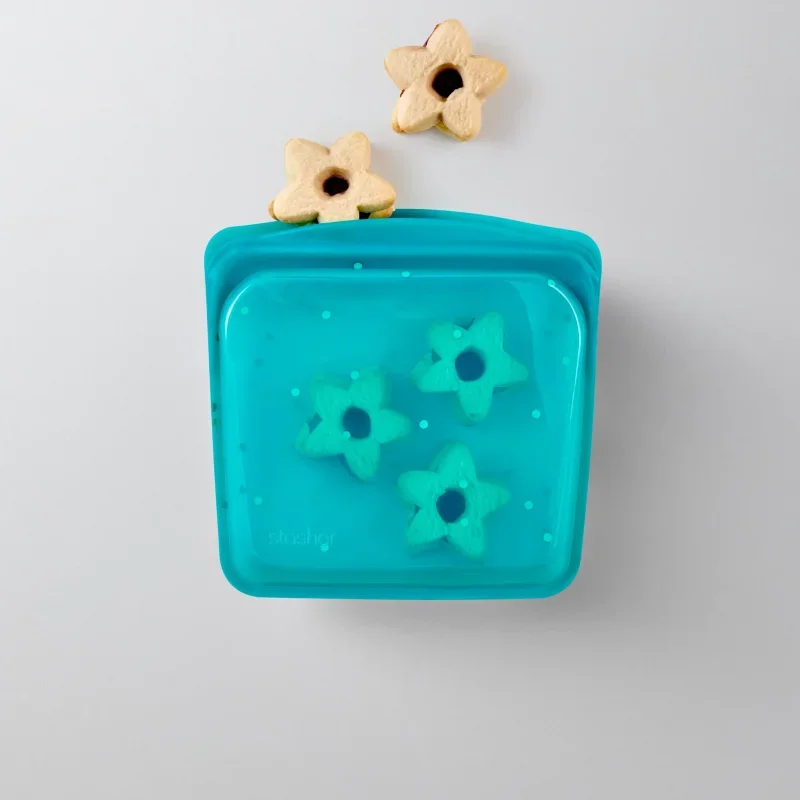
Stasher Platinum Silicone Reusable Storage Bag (Sandwich, Clear)
Stasher
Stasher Platinum Silicone Reusable Storage Bag (Sandwich, Clear)
$11.99
We may earn a commission. It doesn't affect our scores.
You prep food in batches and want to freeze, and oven-bake (to 425°F) in the same container without transferring.
Portability matters — at 2.7 oz, this is the lightest food storage option available, and it collapses flat in an empty lunch bag.
You want a lifetime warranty with no fine print about lid coverage vs. container coverage.
You use it daily and want the dishwasher to handle cleanup without top-rack restrictions or gasket removal.
You need to transport liquids in your bag — the Pinch-Loc press-seal leaks when tilted or jostled under pressure.
You want independent PFAS panel testing — Stasher has LFGB + FDA but hasn't published Mamavation or SGS ICP-MS results.
You need rigid containers that stack in the fridge — silicone bags can't stack the way glass or plastic containers do.
Specs the product listing doesn't explain
What determines how well this performs its core job
What your food and family come into contact with every use
Noise, maintenance, and what happens if something goes wrong
Additional product details
8 criteria — open any layer to see exactly what we found
6.8
Safety
Good
6.9
Efficacy
Good
10
Usability
Excellent
Criteria
The bag is made from the same platinum silicone used in food-contact applications like baby products and medical equipment. It won't leach BPA, BPS, or phthalates. The one-point gap from glass comes down to odor absorption after years of heavy use — not a safety issue, a material property.
There's no plastic lid to worry about here. The whole bag — including the closure — is one piece of silicone. When you're comparing this to glass containers, those almost always have a BPA-free plastic lid that touches your food. The Stasher skips that entirely.
Stasher discloses no BPA, BPS, phthalates, or lead — that's a solid baseline. What's missing is a PFAS-free declaration and any independent lab verification. Caraway, by comparison, publishes third-party panel tests for 200+ PFAS compounds. Stasher hasn't done that publicly.
R3 verdict
The Stasher is built from a single unbroken piece of platinum-cured silicone — body and closure are the same material, so there is no plastic lid touching your food anywhere. That's a cleaner food-contact story than nearly every glass container set on the market, where the lid is almost always BPA-free plastic.
Criteria
LFGB is a serious certification — the German food-contact standard is more rigorous than FDA alone, and it's specifically validated for platinum silicone. But the rubric's top marks go to brands that have submitted to independent PFAS panel testing. Stasher hasn't published that data, so the certification score stops at 6.
R3 verdict
Stasher holds FDA 21 CFR and LFGB certifications — both are meaningful, and LFGB is the strictest food-contact standard globally, including migration testing for platinum silicone. That places Stasher above many silicone bag competitors that have neither.
The ceiling is 6/10 because the rubric's highest-impact qualifier is an independent PFAS panel test (Mamavation, SGS ICP-MS, NSF P235), and no such test has been published by Stasher. This is a resolvable gap — if Stasher were to publish T1 lab results, the certification layer would jump from 6 to 10, adding roughly 0.6 points to the overall score.
Criteria
The Pinch-Loc seal is great for sandwiches and snacks. It won't reliably contain liquids when the bag is tilted or jostled in transit. If you're packing soup or salad dressing to carry somewhere, use a rigid container with snap-lock latches instead.
Tomato sauce won't stain it. Garlic might linger. After storing strongly-scented foods, soak the bag in warm water with baking soda for 30 minutes — that clears most absorbed odors. It's not as odor-resistant as glass, but far better than any plastic container.
R3 verdict
Criteria
The whole bag goes in. No pulling out a gasket, no top-rack-only rule, no hand-washing anything. Silicone is rated for dishwasher temperatures, and because there's no plastic lid component, nothing warps or degrades unevenly.
R3 verdict
The entire bag goes in the dishwasher — no exceptions, no component separation, no top-rack-only restrictions. Unlike glass container sets where lids often require top-rack placement or manual gasket inspection, the Stasher unibody design has nothing to separate, nothing to degrade, and no plastic components to warp.
Over 300+ uses per year, eliminating post-meal hand-scrubbing or top-rack sorting is a genuine time saver. This is where the unibody silicone design pays off most practically.
Criteria
If it tears, cracks, or the seal fails through normal use, Stasher replaces it. There's no expiration date and no fine print about which component is covered. One product, one lifetime warranty.
R3 verdict
Stasher's lifetime warranty is genuine: if the bag fails through normal use, they replace it with the same product or equivalent. For a unibody product with no separable lid, this covers everything — there's no split-warranty confusion about whether the 'container warranty' or the 'lid warranty' applies. This is structurally better than glass container sets that offer lifetime coverage on the plastic lid but only 2 years on the glass — because it's the lid that usually fails first, and the Stasher doesn't have one.
Criteria
You can microwave in the bag, but you need to open the seal first to let steam escape. It's one extra step. No cover means potential splatter and faster moisture loss, but it works fine for reheating most foods.
Freeze food in the bag, pull it straight from the freezer and drop it into sous vide water or the microwave. No defrost step, no container transfer. This is the Stasher's best use case for meal prep.
Criteria
2.7 ounces. That's it. Drops flat in a lunch bag when empty. Won't break if your kid throws their backpack on the ground. For anything that needs to leave the house with you, this format beats glass and stainless every time.
R3 verdict
At 2.7 oz, the Stasher sandwich bag weighs less than most smartphones. It collapses flat when empty, rolls up to fit in a jacket pocket, and won't shatter if it falls out of a child's backpack. For packed lunches, travel snacks, and on-the-go food storage, silicone bags are categorically more practical than glass or stainless containers.
Criteria
At $12 for one bag, the upfront cost is higher than a box of disposable bags. Over years of daily use under a lifetime warranty, the cost-per-use drops to nearly zero. If you use it every day for two years, that's about $0.016 per use.
R3 verdict
At roughly $12 per single sandwich bag, the Stasher is priced at a premium over disposable plastic bags — by design. Against comparable reusable silicone alternatives, it's mid-range.
The lifetime warranty means the per-use cost approaches zero over years of daily use. Strong value overall.
Already have an account? Log in
Verified retailer — current pricing
Starting price
$11.99
We earn a small commission on purchases. It never influences our scores — R3 is funded by readers, not brands.
Alternatives that address specific trade-offs
Why this matters: Stasher holds FDA 21 CFR and LFGB certifications — both are meaningful, and LFGB is the strictest food-contact standard globally, including migration
Didn't find the food storage container you need?
See all food storage containers we reviewed#1 of 8 food storage containers reviewed
The tradeoff is that platinum silicone sits one tier below glass on the chemical inertness scale. It has a strong safety record, but independent long-term migration data is thinner than for glass.
Stasher's LFGB certification validates the silicone's safety, but no independent PFAS panel test has been published — a gap worth noting at this price.
The Pinch-Loc seal works reliably for the bag's core use cases: sandwiches, produce, marinating, and freezer storage. The press-to-seal design is intuitive once you learn the technique — just run your fingers along the top edge until you feel and hear it click into place.
Where it falls short is liquid transport under pressure. Consumer Reports water-slosh tests found silicone press-seal designs — including Stasher — leaked when carried in a bag and jostled.
For dry and semi-moist foods it's excellent; for carrying salad dressing or soup upright, a rigid container with a 4-latch snap-lock lid is more reliable.
You can bake in it at 425°F. Roasted vegetables, small portions, reheating casseroles — all covered. If your recipe calls for above 425°F, transfer to a pan instead.
R3 verdict
The Stasher handles freezer and oven (to 425°F) without transferring containers — covering the core meal prep cycle. Microwave use requires opening the seal slightly to allow steam escape before heating.
The 425°F oven ceiling covers the vast majority of home cooking. The microwave score of 5 reflects the requirement to open the seal first — a minor inconvenience but a real step.
For most families, the freeze-to-oven workflow is the standout capability.
R3 verdict
The Stasher handles freezer and oven (to 425°F) without transferring containers — covering the core meal prep cycle. Microwave use requires opening the seal slightly to allow steam escape before heating.
The 425°F oven ceiling covers the vast majority of home cooking. The microwave score of 5 reflects the requirement to open the seal first — a minor inconvenience but a real step.
For most families, the freeze-to-oven workflow is the standout capability.