Compare Dutch Oven
Which scores higher on safety? R3 breaks it down.
The most important dimensions, side by side.
7-day free trial · Cancel anytime
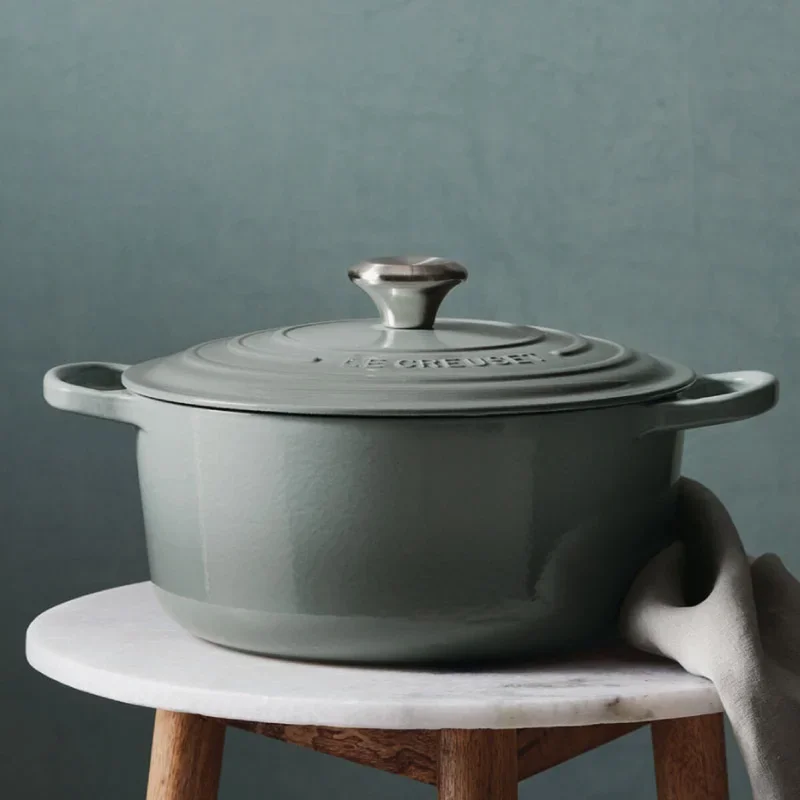
Le Creuset's light interior enamel is made in France and the brand explicitly documents it as free of lead and cadmium. French manufacturing carries legally mandated EU food safety requirements — a meaningful baseline, just not the same as a product that publishes third-party lab test results for each production batch.
No independent lab has confirmed this product's food-contact safety with a published certificate for US-distributed units. Le Creuset manufactures in France under EU standards — the material safety case is strong — but if you want a third-party lab report to point to, one hasn't been found for this specific SKU.
No independent lab certificates are publicly available for this pot — no LFGB document, no SGS report, no NSF listing. Made In references third-party heavy-metals testing in blog posts, but without a published certificate to point to, we can't confirm the claim at the level that earns certification credit. If you need a document in hand before buying, this is the gap to close.
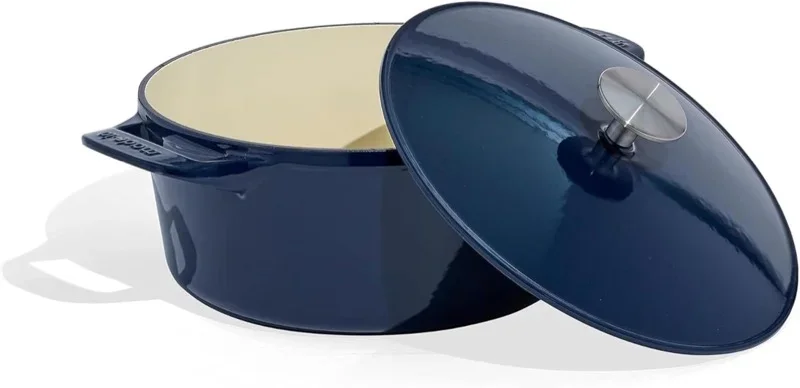
Made In makes this pot in France, where EU rules on food-contact materials are among the world's strictest. An independent lab tested the enamel for lead and cadmium migration and it passed — that's meaningful. What's missing is a published German LFGB safety certificate that the top-scoring Dutch ovens carry, so full marks aren't possible here.
Rated to 500°F, which is the threshold that lets this pot do everything — bread baking, high-heat roasting, stovetop-to-oven searing. No-knead bread specifically needs that 500°F ceiling for proper crust development. The Signature line's stainless steel knob makes this possible.
5.5 quarts is the family sweet spot — big enough for a whole chicken, six servings of soup, or a standard sourdough loaf, but not so large it's awkward on a home stove. If you regularly cook for eight or more, the 7.25 qt version is worth considering.
Rated to 580°F, which covers every home cooking technique without exception — no-knead bread at full oven temperature, high-heat searing before a braise, long slow roasts. Most Dutch ovens top out at 450–500°F, so this is genuinely above average headroom.
At 5.5 quarts, this hits the family cooking sweet spot — big enough for a whole chicken, a large batch of chili, or a standard sourdough loaf, but not so large it's awkward on a home burner. It's the same capacity as the most popular Le Creuset and Staub models.
The lid fits snugly and traps steam reliably — your braising liquid stays in the pot where it belongs. It doesn't have the interior condensation nubs that Staub uses to actively baste food during cooking, but for most family recipes that distinction only matters to experienced braising enthusiasts.
Made In's Cloud Cover Lid is the standout feature here. The pea-sized bumps on the underside catch steam, condense it, and drip it back evenly over your food throughout the cook — essentially self-basting without any effort from you. Most Dutch ovens at this price, including Le Creuset, use a smooth dome that lets condensation drip back haphazardly.
At 11.5 pounds before you add a drop of food or liquid, this is a heavy pot by any home kitchen standard. Most adults can manage it safely with both hands, but it requires planning — especially when pulling it out of a wall oven at shoulder height. It's among the lighter options in the cast iron category, but cast iron is simply heavier than alternatives.
At nearly 14 pounds empty, this is one of the heavier 5.5 qt Dutch ovens available. Add food and liquid and you're lifting 20-plus pounds in and out of a hot oven. If you cook frequently or have any wrist, shoulder, or grip limitations, this weight deserves serious consideration — the Le Creuset 5.5 qt comes in roughly 1.5 lbs lighter.
Le Creuset covers manufacturing defects in the enamel and construction for as long as you own the pot — no expiration date. The 'limited' part means it excludes damage from dropping the pot or extreme temperature changes, which is standard for the category. It's still one of the most protective warranties in cookware.
The cream-colored interior is genuinely useful, not just pretty. You can see exactly when your onions have turned golden, when fond is forming, and how much liquid is left in the pot — all things that are much harder to judge in a pot with a dark interior. America's Test Kitchen specifically called out this visibility advantage as a key reason they recommend Le Creuset over Staub.
Le Creuset explicitly approves dishwasher use — which matters on the evenings when you've been cooking for two hours and the last thing you want to do is scrub a heavy pot by hand. Hand washing is still recommended for long-term enamel care, but the option to machine wash is real and appreciated.
Made In recommends hand washing and notes that dishwasher use voids the warranty. In practice, cast iron Dutch ovens clean up easily with warm water and a soft brush — so this rarely feels like a burden. But if you depend on your dishwasher for heavy cookware after long meals, that flexibility isn't available here without risking your warranty coverage.
Made In backs this pot with a lifetime warranty, which is a strong long-term commitment. The limitation to know: it excludes enamel damage from metal utensils, thermal shock, and dishwasher use — so it covers manufacturing defects, not wear from normal cooking mistakes. Use wood or silicone utensils and hand wash, and you're well-positioned for coverage that lasts.
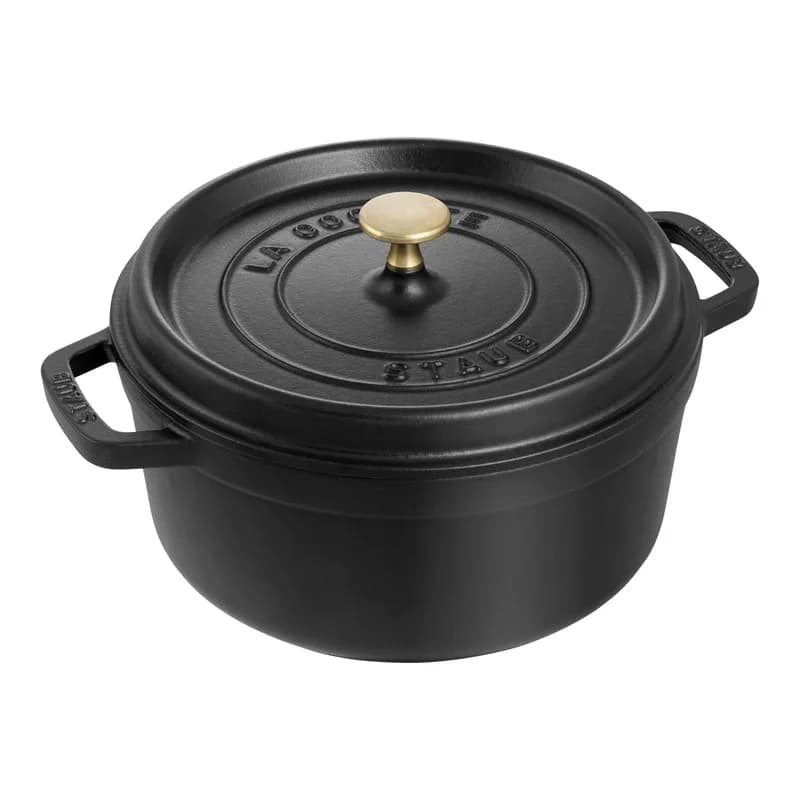
The light cream interior is genuinely useful while cooking — you can see exactly when your fond starts to form, when aromatics are golden, and how much liquid remains. Staub's matte black interior is beautiful but makes those visual cues much harder to read, especially in lower light.
Everything you need to make the call — who each one is for, and who should skip it.
Go for it if you...
You bake no-knead bread and need a pot rated to 500°F — this hits the ceiling the technique requires, and nothing about the lid or knob limits you.
You value cooking visibility and want to see exactly when fond forms and aromatics are done without guessing in a dark pot.
You're buying a Dutch oven to last 20-plus years and want the most recognized lifetime warranty in the category.
You cook for 4 to 6 people and want a 5.5qt that handles a whole chicken, a full batch of chili, or a Sunday braise in one round.
You want a self-basting lid that actively returns moisture to food during long braises — the Cloud Cover Lid is a real functional upgrade over a standard dome lid at the same price.
You bake bread at high heat and need a Dutch oven rated above 500°F — this goes to 580°F, outpacing most competitors including Le Creuset.
You value a light cream interior that lets you monitor browning and fond development without guessing, especially compared to Staub's dark interior.
You cook for a family of 4–6 and the 5.5 qt capacity is your target — it's the ideal size for most family-scale recipes.
You're comfortable with hand washing cast iron and want a lifetime warranty on a pot you expect to keep for decades.
The main thing to know
No independent lab certificate backs the food-safety claims for US-distributed units — the EU manufacturing standards are legally strong, but no LFGB document has been publicly confirmed. That's a meaningful gap at $435.
Made In has not published an LFGB or SGS safety certificate for this pot, which caps the safety score at baseline on certifications — and at 13.69 lbs empty, this is one of the heavier 5.5 qt Dutch ovens at any price.
Skip this if you...
You need a third-party lab certificate for the food-contact surface before cooking acidic foods daily — one hasn't been publicly confirmed for US-distributed units.
You have wrist or shoulder concerns — 11.5 lbs empty becomes well over 20 lbs fully loaded, and that's a real consideration for daily use.
Your budget is under $200 — comparable Dutch oven performance is available for significantly less, and the premium here is largely brand and heritage.
You need a published LFGB or SGS safety certificate before buying — Made In has not released one publicly, and this is a meaningful gap for safety-first families.
You have wrist, shoulder, or grip limitations — 13.69 lbs empty (20-plus lbs full and hot) is on the heavy end for frequent use.
You want a dishwasher-safe Dutch oven — using the dishwasher voids the warranty and can damage the enamel over time.
Neither of these quite what you're looking for?
I've reviewed all Dutch Oven options at every price pointEvery Dutch Oven in our database is scored using R3's V4.2 deterministic rubric — the same inputs always produce the same score. For this comparison, we evaluated Le Creuset and Made In across 3 independent criteria: Safety (45%), Efficacy (25%), Usability (30%). No sponsored rankings. No paid placements.
Straight answers — no sponsored content, no filler.
Both scored close to 7.2/10, so the better choice depends on your priorities. Safety carries 50% of our scoring weight, followed by performance (20%), usability (20%), and value (10%). Check which pillar matters most to your family and compare those specific scores.
We use our V4.2 deterministic rubric with four weighted pillars: Safety (50%), Efficacy (20%), Usability (20%), and Value (10%). Every score is reproducible - the same product data produces the same score. Each product is evaluated across multiple criteria within each pillar.
Not necessarily. The overall score reflects our weighted rubric, but your priorities may differ. If you care most about safety, compare the safety scores directly. If budget drives your decision, the value scores and prices tell a clearer story. The "right" pick is the one that matches what matters most to your family.
Not the right match? Explore these alternatives in the same category.