Compare Air Fryers
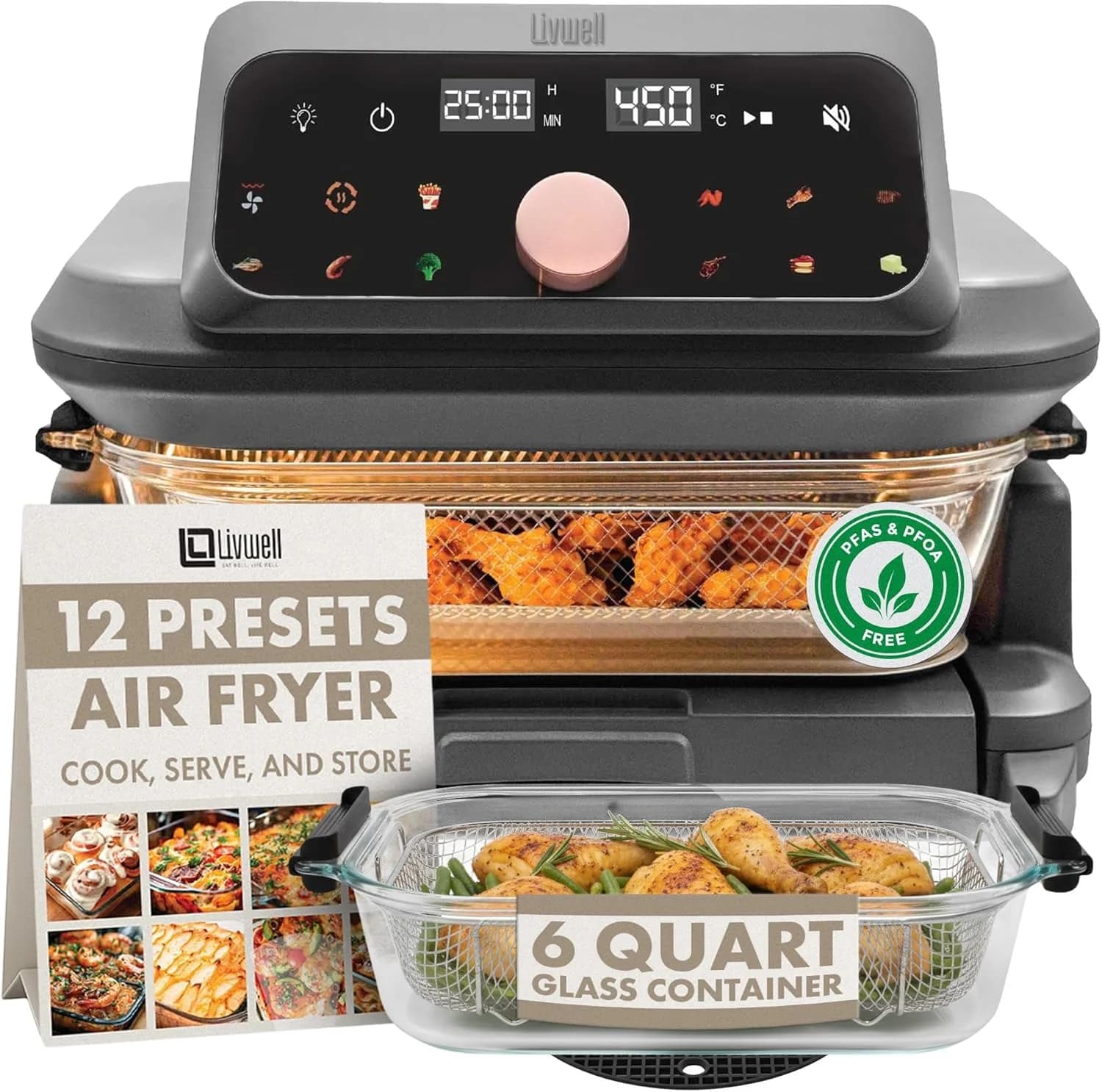
Granitestone Big Boss 16Qt Large Glass Air Fryer scores higher on safety - here's why.
The most important dimensions, side by side.
The crisper plate base is bare aluminum without food-grade certification. Scores 4/10.
The racks are stainless steel but the specific grade (304, 316, 18/8) is not disclosed. Likely food-safe but unconfirmed.
Ceramic nonstick coating explicitly marketed as PFAS-free. But ceramic coatings can chip and degrade over time.
Glass bowl and bare stainless steel racks -- nothing to chip, flake, or degrade.
The basket is bare aluminum. Source says aluminum without food-grade qualifier.
The glass bowl is tempered glass. Food-safe but less chemically inert than borosilicate glass.
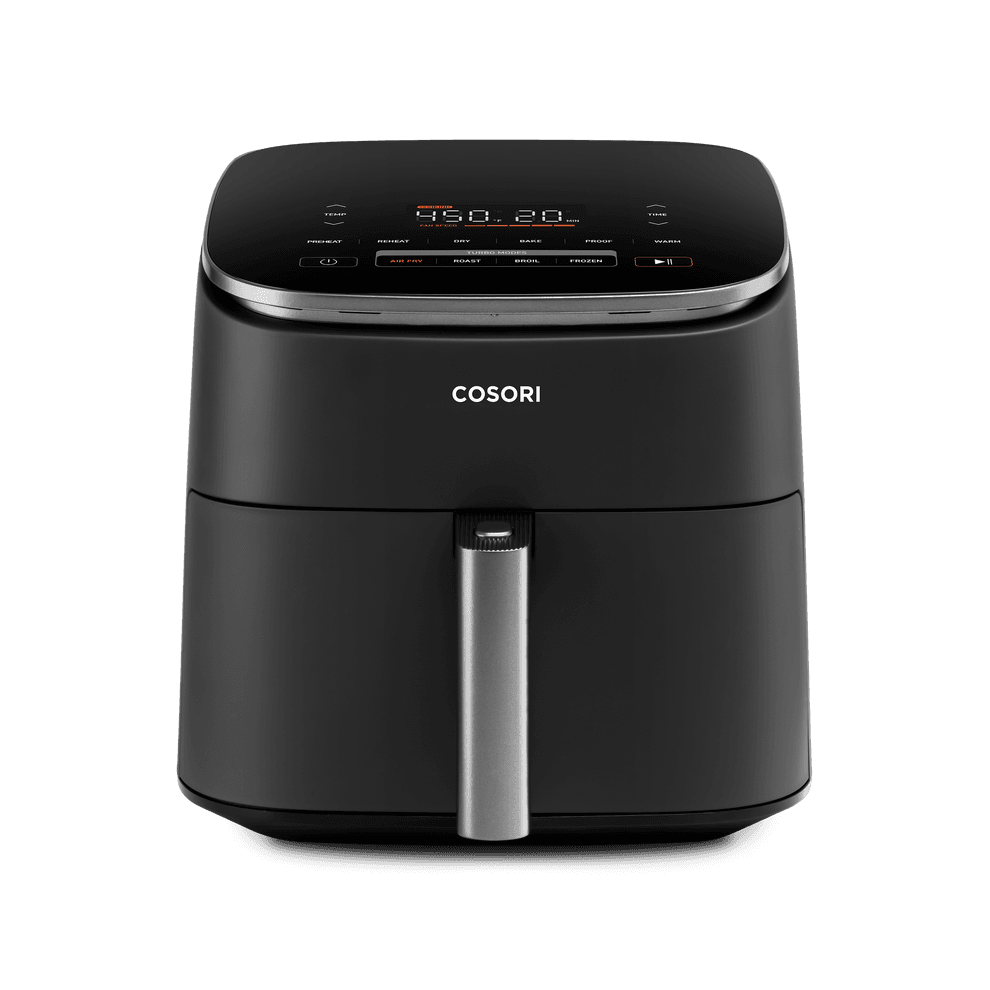
Cosori explicitly claims PFAS-Free Ceramic Coating on this model. No independent lab has verified this, but it is a stronger claim than the Pro LE which only claims PFOA-free.
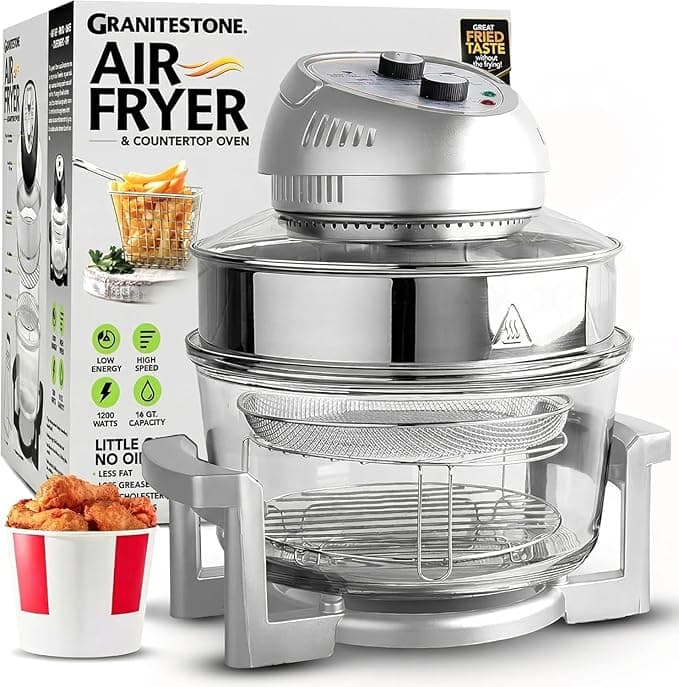
Granitestone claims the product is free of Teflon and forever chemicals. Glass + stainless inherently lack PFAS, but no third-party testing published.
Square basket design for optimal crisping and airflow.
Glass bowl with halogen, convection, and infrared heating provides 360-degree cooking.
At 1725 watts with DC motor, this is the most powerful air fryer in the lineup. Fast preheat and excellent temperature recovery.
At 1300 watts, preheating is slower than higher-wattage competitors.
Full temperature adjustability from 90 to 450 degrees F.
Temperature adjustability not confirmed in sourced data.
Both basket and crisper plate are dishwasher safe.
All removable parts including the glass bowl go in the dishwasher.
Less than 53 dB even on highest fan speed -- among the quietest basket-style air fryers.
No noise measurement published by manufacturer or any independent lab.
2-year limited warranty from Cosori.
Standard 1-year limited warranty.
Good value at $99.99 for a high-wattage 6-quart air fryer.
$129.99 for 16 quarts of zero-coating glass + stainless steel cooking.
Everything you need to make the call - who each one is for, and who should skip it.
Go for it if you...
You want the strongest cooking performance available -- 1725W TurboBlaze with DC motor.
Quiet operation matters -- less than 53 dB even on the highest fan speed.
You want an explicit PFAS-free claim from a well-known brand and are comfortable with manufacturer self-reporting.
You cook for three to five people and want a 6-quart, dishwasher-safe, square-basket design with a 2-year warranty.
You want a large-capacity (16 qt) glass air fryer with zero coatings at a mid-range price.
Dishwasher-safe parts (including the glass bowl) matter for easy cleanup.
You want the glass bowl convection cooking experience with halogen + infrared.
The main thing to know
The PFAS-Free Ceramic Coating is a manufacturer marketing claim -- no independent lab has tested or certified it. The food-contact surfaces are ceramic-coated bare aluminum, and the ceramic coating introduces a degradation pathway absent in uncoated surfaces. Both basket and crisper plate are aluminum without food-grade certification.
The Granitestone Big Boss uses tempered glass and stainless steel racks with zero coatings -- strong material safety. The stainless steel grade is unconfirmed (generic, not 304). ETL certification is referenced in Amazon text but not independently verified.
Skip this if you...
You want uncoated food-contact surfaces -- look at glass or bare stainless steel air fryers instead.
You require third-party PFAS-free verification (NSF 537 or lab testing), not just a manufacturer claim.
You prioritize material purity above all else -- the ceramic-coated bare aluminum design scores below average on safety.
Budget is a concern -- at $99.99, other models offer better material safety at similar or lower prices.
You need confirmed 304 or 316 stainless steel on food-contact surfaces.
You want independent PFAS verification beyond manufacturer claims.
You need independently confirmed UL/ETL certification.
Neither of these quite what you're looking for?
I've reviewed all Air Fryers options at every price pointEvery Air Fryers in our database is scored using R3's deterministic scoring system - the same inputs always produce the same score. For this comparison, we evaluated Cosori and Granitestone across 3 independent criteria: Safety (90%), Efficacy (7%), Usability (3%). No sponsored rankings. No paid placements.
Straight answers - no sponsored content, no filler.
The Cosori 9-in-1 TurboBlaze Air Fryer 6 Qt uses a bare-aluminum basket with a bare-aluminum crisper plate. PTFE-coated nonstick may contain trace PFAS compounds, which is reflected in its 4.3/10 safety score in our scoring system. For a PFAS-free alternative, look for models with stainless steel or borosilicate glass baskets.
Between these two, the Granitestone Big Boss 16Qt Large Glass Air Fryer (borosilicate glass basket, 7.7/10 safety) uses materials I'm more comfortable with at high heat. The Cosori 9-in-1 TurboBlaze Air Fryer 6 Qt's bare-aluminum basket scored 4.3/10. In our scoring system, basket material accounts for a significant portion of the safety pillar, which is our highest-weighted scoring factor.
For families, capacity comes first: Cosori offers 6-qt vs Granitestone's 16-qt. Overall, I'd lean toward Granitestone for most families.
304 stainless steel is inherently PFAS-free and won't off-gas at any cooking temperature. Nonstick coatings (PTFE/Teflon) are stable below 400°F but can begin degrading above that threshold. In our scoring system, stainless and borosilicate glass baskets consistently score higher on the safety pillar. That said, a well-maintained nonstick basket from a reputable brand still meets safety baselines - it's a question of margin, not danger.
R3 uses a deterministic scoring system - the same inputs always produce the same score. We evaluate each Air Fryers across Safety, Efficacy, Usability using independently verified data. No sponsored rankings. No paid placements. Every score is fully reproducible.
Not the right match? Explore these alternatives in the same category.