Compare Air Purifiers
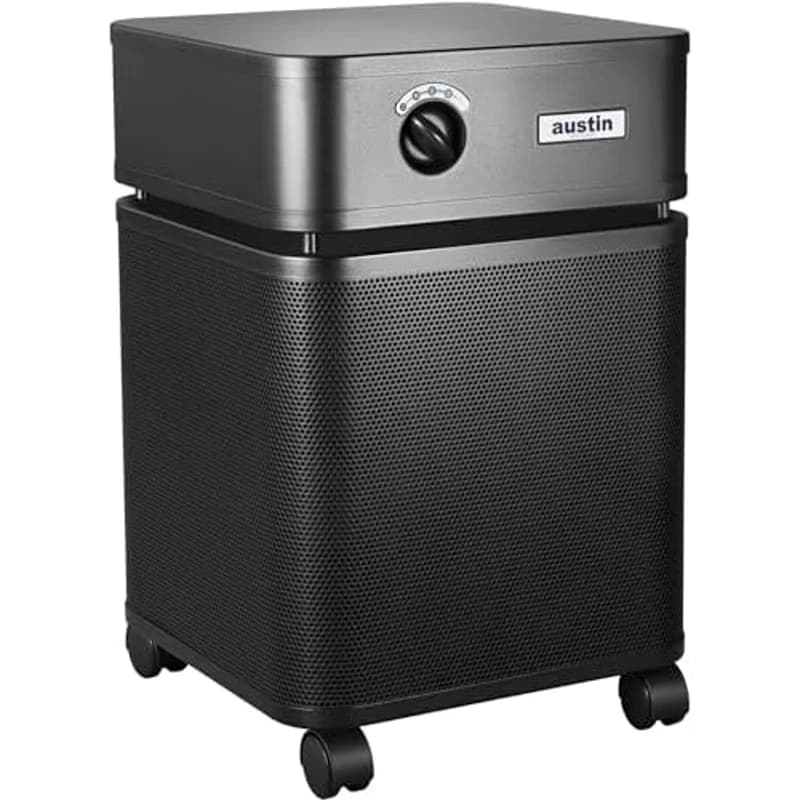
Austin Air HealthMate (HM400) scores higher on safety - here's why.
R3 scored the Austin Air HealthMate (HM400) 7.7/10 and the Coway Airmega 400 (AP-2015F) 6.6/10 on the same air purifiers scoring system, weighing safety, efficacy, and usability. The Austin Air HealthMate (HM400) comes out ahead, led by its safety score (9.1/10 vs 7.1/10).
The most important dimensions, side by side.
See which one actually scores higher — and why
Free account unlocks full safety scores, spec-by-spec breakdown, and the R3 verdict on Austin Air HealthMate (HM400) vs Coway Airmega 400 (AP-2015F).
Unlock the full Austin Air HealthMate (HM400) vs Coway Airmega 400 (AP-2015F) breakdown
Free account unlocks all safety scores, complete spec comparison, scoring rationale, and the R3 verdict on which one to buy.
Everything you need to make the call - who each one is for, and who should skip it.
Go for it if you...
You have chemical sensitivities, MCS, or are recovering from a renovation, new construction, or VOC exposure event
Wildfire smoke or heavy outdoor pollution is a persistent concern and you want the deepest chemical absorption available
You want a set-and-forget machine — the 5-year filter life means minimal maintenance
You're furnishing a baby's room or play area and want the safest possible filtration technology
Long-term filter economics matter — $350/year is among the lowest annual costs in the premium category
You want a quiet, no-ozone True HEPA and activated-carbon purifier from an established brand
You have a large open living area or open-plan space and want fast particle clearing during wildfire season or after cooking
You will run it overnight in or near a bedroom and want it close to silent on sleep mode
You are comfortable that some build-material details, like the housing and carbon weight, are not published
You prefer changing filters just once a year
The main thing to know
The 1,500 sq ft coverage claim is based on 2 air changes per hour — real-world particle-clearing coverage at AHAM's 5 ACH standard is closer to 300–400 sq ft. Buy it for a room, not a home.
Coway does not disclose what the housing is made of, so the plastic type, BPA status, and flame-retardant content are unknown for a device meant to run continuously in living spaces.
Skip this if you...
You need to cover a medium or large room (above 400 sq ft) with meaningful air changes — 156 CFM won't do it
You're expecting whole-home or open-plan coverage — this is a single-room machine
You're on a tight upfront budget — at $845, the purchase price is high even if the running costs are low
You need the full housing-material breakdown before putting a unit in a child's room
You are matching this to a single large room at a true five-air-changes-per-hour pace, where it covers closer to 500 square feet than the advertised 1,560
You are tackling heavy chemical off-gassing from new construction or renovation, where an unpublished carbon weight is a real unknown
You want a lower-priced unit and do not need this much airflow
Neither of these quite what you're looking for?
I've reviewed all Air Purifiers options at every price pointEvery Air Purifiers in our database is scored using R3's deterministic scoring system - the same inputs always produce the same score. For this comparison, we evaluated Austin Air and Coway across 3 independent criteria: Safety (75%), Efficacy (23%), Usability (2%). No sponsored rankings. No paid placements.
Straight answers - no sponsored content, no filler.
I'd start with Austin Air Austin Air HealthMate (HM400) - it scored 7.7/10 overall in our scoring system. Safety is our top-weighted scoring pillar, followed by efficacy, and usability. Check which pillar matters most to your family and compare those specific scores.
R3 uses a deterministic scoring system - the same inputs always produce the same score. We evaluate each Air Purifiers across Safety, Efficacy, Usability using independently verified data. No sponsored rankings. No paid placements. Every score is fully reproducible.
Not necessarily. The overall score reflects how we weight those three pillars, but your priorities may differ. If you care most about safety, compare the safety scores directly. If budget drives your decision, the prices tell a clearer story. The "right" pick is the one that matches what matters most to your family.
Not the right match? Explore these alternatives in the same category.