Key Specs
Price
$299 USD
Wattage
N/A — stovetop/oven cookware
Capacity
5.5 qt
Max Oven-Safe Temp
500°F
Staub
#4 of 7 dutch ovens tested
$299.00
What the product listing won't tell you
Know before you buy
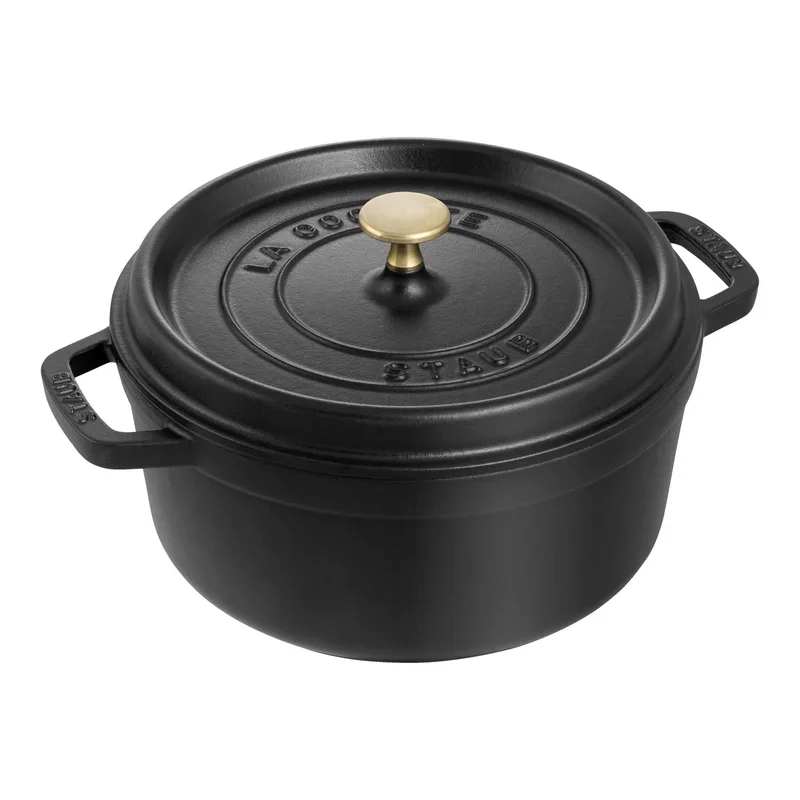
The black interior is Staub's defining trade-off — experienced cooks love it, but if you're still learning to read a braise by sight, you'll find yourself guessing more than you should with a $299 pot.
You already cook braises and stews regularly and want the best self-basting lid in the category — Staub's spike system genuinely outperforms a smooth lid for moisture return.
Staub
Staub Cast Iron Round Cocotte Dutch Oven (5.5 qt)
Staub
Staub Cast Iron Round Cocotte Dutch Oven (5.5 qt)
We may earn a commission. It doesn't affect our scores.
You bake no-knead bread and need a 500°F-safe pot that can handle the thermal demands of proper oven spring and crust.
You want premium enameled cast iron manufactured under EU LFGB standards (lead/cadmium-free, legally audited) at a step below Le Creuset pricing.
You cook for a family of 4–6 and need a pot large enough for a whole chicken, a full pot of chili, or a generous batch of soup without upgrading to a bulky 7qt.
You plan to keep this pot for decades and want lifetime warranty coverage on the enamel and construction.
You're new to Dutch oven cooking and want to monitor your braise visually — the black interior makes it much harder to see fond development and browning without significant experience.
You need to lift a heavy pot frequently, have wrist or shoulder limitations, or use a wall oven at height — 12.5 lbs empty and 20+ lbs loaded is real weight to manage regularly.
You require independently lab-verified safety certifications for US market distribution — Staub's LFGB compliance is strong but not the same as a lot-by-lot third-party test report.
Safety standards and ingredients related to Staub Cast Iron Round Cocotte Dutch Oven (5.5 qt)
Every term is independently researched and sourced.
Full Safety DictionarySpecs the product listing doesn't explain
What determines how well this performs its core job
What your food and family come into contact with every use
Noise, maintenance, and what happens if something goes wrong
5 criteria — open any layer to see exactly what we found
5.9
Safety
Mixed
10
Efficacy
Excellent
5.1
Usability
Mixed
“Is the black enamel actually safe, or is it hiding something?”
Criteria
The interior is French porcelain enamel — a glass-like surface fused to the cast iron that won't leach lead or cadmium into your food. Staub manufactures under strict EU standards that legally require this. It's a strong safety baseline, even though no US lab has independently confirmed it batch by batch.
No independent lab has tested this product's enamel for the US market — there's no NSF certification or third-party safety report on file. The brand's EU manufacturing standards are strong and legally enforced, but if independently verified lab results matter to you, they're not available here yet.
R3 verdict
The porcelain enamel is genuinely safe — manufactured under French LFGB standards, which legally cap heavy metals in food-contact surfaces. Staub discloses that the interior is lead-free and cadmium-free, and this is audited, not self-reported on a label.
The gap is US third-party certification. No NSF cert, no independent lab test for US distribution batches.
For most families, LFGB French manufacturing is more than sufficient. For buyers who want a lab report they can read themselves, that documentation doesn't exist for this product.
Solid safety baseline for families who trust EU manufacturing standards. If independently verified batch-level testing is a requirement, this product doesn't offer it.
“Can this pot do everything — braising, bread, and roasting — or does the heat ceiling limit you?”
Criteria
Safe to 500°F means you can bake no-knead bread (which actually needs that heat for proper crust and oven spring), sear at high heat before a braise, or roast aggressively. No temperature ceiling gets in your way.
5.5 quarts is the sweet spot for families — fits a whole chicken, a full pot of soup for 6, a large batch of chili, or a standard no-knead bread loaf. Big enough to be truly useful, not so large it's awkward on a home burner. If you regularly cook for 8 or more, consider the 7.25 qt instead.
“Is this too heavy to use regularly, or just heavier than expected?”
Criteria
This pot weighs 12.5 lbs empty. Add food, liquid, and the lid and you're moving 20+ lbs — at oven height, potentially. If you have a wall oven or any wrist or shoulder concerns, test your comfort with this weight before buying. It's not a dealbreaker for most people, but it becomes fatiguing if you use it several times a week.
R3 verdict
Cast iron is always heavy — that's the physics of the material. At 12.5 lbs empty and 20+ lbs loaded, this is on the heavier end of the category.
For occasional weekend cooking, that's fine. For daily use or anyone lifting from a wall oven at shoulder height repeatedly, it adds up.
This isn't unique to Staub — it's the category trade-off. But if weight is a real concern, enameled cast iron of this size is the wrong category.
“Does the lid actually do something special, or is it just a lid?”
Criteria
The lid has interior spikes that collect steam and drip it back over the food in a steady, even pattern — so your braise is essentially self-basting the whole time without you touching it. That's the difference between meat that's been continuously moistened and meat that dried out while steam dripped off randomly. The spikes take a bit more effort to clean; a soft brush gets into them easily.
R3 verdict
It does something special. The interior spike system is purpose-built to solve the basting problem — steam condenses on the spikes and falls back over the food in an even pattern rather than dripping randomly to one side of the pot.
For braises and stews, this produces genuinely better results: more even moisture distribution, less manual intervention, and no heat loss from lifting the lid to baste. It's one of the strongest performance differentiators in the Dutch oven category.
“Is this pot high-maintenance, and does the black interior actually cause problems day to day?”
Criteria
Lifetime limited warranty means Staub stands behind the enamel and construction for the life of the pot. The 'limited' part matters — cosmetic sand-casting variations and misuse damage aren't covered. But genuine manufacturing defects in the enamel? Covered. Read the Zwilling warranty terms so you know the line before you need it.
The black interior is Staub's signature — and a real trade-off. You genuinely cannot see fond development, how far aromatics have browned, or how much your sauce has reduced without either experience or a flashlight. Experienced cooks often prefer this; they know what done looks like by smell and timing. If you're newer to braising, expect a learning curve that a cream-interior pot (like Le Creuset) wouldn't require.
Verified retailer — current pricing
Starting price
$299
We earn a small commission on purchases. It never influences our scores — R3 is funded by readers, not brands.
Alternatives that address specific trade-offs
Why this matters: Cast iron is always heavy — that's the physics of the material. At 12.5 lbs empty and 20+ lbs loaded, this is on the heavier end of the category. For

Le Creuset
Scores 6.0/10 on physical handling vs 4.0 here

Emile Henry
Scores 8.0/10 on physical handling vs 4.0 here
Didn't find the dutch oven you need?
See all dutch ovens we reviewed#4 of 7 dutch ovens reviewed
R3 verdict
At 500°F, nothing is off the table. You can start a braise with a hard sear on the stovetop, move it to a 325°F oven for three hours, then use the same pot for a 500°F no-knead bread bake the next morning.
The 5.5qt capacity is the right size for most family cooking without becoming too heavy or unwieldy. If you cook for crowds regularly, the 7.25qt is worth considering — but for everyday family use, 5.5qt is the right call.
For families who want one pot that handles the full range — braising, soup, stew, and artisan bread — without any thermal limitations.
Not ideal for daily cooks with grip or shoulder limitations. Well within the range for healthy adults using it a few times per week.
If braising and slow-cooking are your primary use cases, the self-basting lid is a meaningful functional upgrade over a smooth lid.
You can run it through the dishwasher if needed — the brand confirms it won't cause immediate damage. But hand washing is the right move for an expensive pot you plan to use for decades. Dishwasher detergent is aggressive, and the enamel finish will hold up longer with a quick hand wash.
R3 verdict
The black interior causes real, recurring friction. Every time you check whether the fond is deep enough, whether the onions are soft, or whether the braise has reduced — you're guessing more than you would with a light interior.
It's the kind of thing that experienced cooks adapt to quickly and beginners find genuinely frustrating. The warranty is excellent for the category, and hand washing is a minor ask for a pot at this price point.
The weight and the black interior are the two friction points that accumulate over repeated use.
Best for cooks who already know Dutch oven cooking well enough that the black interior doesn't slow them down. Not ideal for families building their braising skills.