R3 – Research, Reviews, Recommendations
    R3 – Research, Reviews, Recommendations
    How we score
    Loading...
    R3 – Research, Reviews, Recommendations

    Independent, non-toxic product reviews for families who research.

    Reviews & research

    • Product reviews
    • Compare products
    • Buying Guides
    • Research
    • Safety Dictionary
    • How we score

    Popular categories

    • Water Filter
    • Kids Backpack
    • Kids Vitamins
    • Kids Snacks
    • Air Purifier

    Company

    • About
    • Pricing
    • Contact
    • For Brands

    Legal

    • Privacy
    • Terms
    • Affiliate disclosure
    Fully independent
    2,000+ citations verified
    Research-verified
    93+ Categories
    969+ products safety-scored

    We do the research. You get the picks.

    Non-toxic picks, safety alerts, and research updates — straight to your inbox.

    © 2026 R3 Platform LLC. All rights reserved.

    FacebookInstagramX (formerly Twitter)
    TikTok
    YouTube
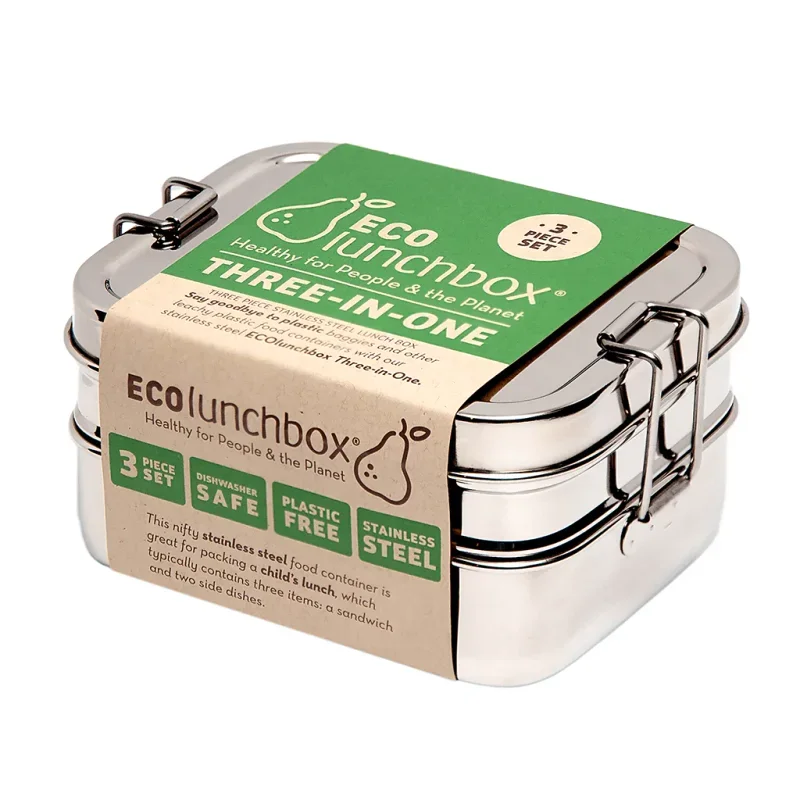
    KitchenLunch BoxECOlunchbox Three-in-One Stainless Steel Bento Box
    #4 of 7
    ECOlunchbox Three-in-One Stainless Steel Bento Box

    Key Specs

    Body Material

    201 food-grade stainless steel

    Gasket / Seal Material

    None (all-metal design)

    Leak-Proof

    No — tray design

    Compartments

    3 nesting containers (large 14oz, medium 12oz, snack pod 5oz)

    ECOlunchbox

    ECOlunchbox Three-in-One Stainless Steel Bento Box

    #4 of 7 lunch boxs tested

    5.8R3 Score / 10
    There are better options — here's why.
    Safety
    4.848% weight
    Usability
    7.330% weight
    Efficacy
    5.822% weight

    $24.95

    Buy on Amazon

    The bottom line

    What the product listing won't tell you

    Know before you buy

    The Three-in-One is one of the simplest and least expensive all-metal, plastic-free lunch boxes available — but its press-fit nesting design makes it genuinely hard for young children to open independently, and it cannot hold any liquid.

    Buy it if
    • Your child is 6 or older and can pull apart nested metal containers without teacher help.

    ECOlunchbox Three-in-One Stainless Steel Bento Box

    ECOlunchbox

    ECOlunchbox Three-in-One Stainless Steel Bento Box

    $24.95
    Buy on Amazon
    ECOlunchbox Three-in-One Stainless Steel Bento Box

    ECOlunchbox

    ECOlunchbox Three-in-One Stainless Steel Bento Box

    $24.95Buy on Amazon

    We may earn a commission. It doesn't affect our scores.

  1. Their typical lunch is dry foods — sandwiches, cheese, crackers, grapes, carrots — with no sauces or wet items that need containment.

  2. You want all-stainless construction with zero plastic components and are comfortable with brand-declared (not lab-verified) safety claims.

  3. You want the easiest possible cleanup — three pieces, no disassembly, straight into the dishwasher.

  4. You're looking for an all-stainless lunch box at the lowest possible price point.

  5. Skip if
    • Your child is under 6 — the press-fit nesting design will require teacher help at lunch daily.

    • Their lunch regularly includes sauces, dressings, yogurt, or juicy fruits — this box will leak.

    • You require a published third-party food-contact safety certification — no LFGB, NSF, or independent lab test has been published for this product.

    • You want 304-grade (food-service standard) stainless, not 201-grade.

    Safety research

    Safety standards and ingredients related to ECOlunchbox Three-in-One Stainless Steel Bento Box

    Ingredients avoided
    ingredients
    Microplastics from Heated Plastics- Microscopic plastic particles smaller than 5mm (microplastics) and smaller than 1 micrometer (nanoplastics) that shed from plastic components when repeatedly heated. Recent studies show heated plastics release millions of micro- and nanoplastic particles per gram. These particles have been found in human blood, placenta, and breast milk, and can carry other chemicals like phthalates and BPA as they leach into food and air.
    ingredients
    Melamine- An organic compound used to make hard, heat-resistant plastic (melamine resin). Found in cheap air fryer accessories, dishes, and utensils. Leaches formaldehyde when heated above 160 degrees F (70 degrees C). Not safe for high-heat cooking. Associated with kidney damage and the 2008 Chinese milk contamination scandal.
    ingredients
    Phthalates- A group of plasticizer chemicals used to make plastics flexible and durable. Found in PVC, vinyl, food packaging, personal care products, and kitchen appliance components. Phthalates are endocrine disruptors that affect testosterone and thyroid hormones, with strong evidence linking them to reproductive harm, particularly in developing boys.
    ingredients
    BPS (Bisphenol S)- A common replacement for BPA found in thermal receipt paper, plastics, and food containers. BPS binds to estrogen receptors at similar potency to BPA and has been detected in 81% of Americans tested. Many products labeled BPA-free contain BPS instead.
    Standards met
    standards
    FDA Food Contact Rules (21 CFR)- The U.S. regulatory framework governing every material that can touch your food - from nonstick coatings on air fryer baskets to plastic containers, packaging films, and can linings. Codified in Title 21 of the Code of Federal Regulations (21 CFR), Parts 170-199, these rules define which substances are permitted in food contact applications, what migration limits apply, and how manufacturers prove compliance. Critically, FDA does not pre-approve finished cookware - meaning that "FDA compliant" on a product label is a manufacturer's self-declaration, not a government stamp of approval.
    concepts
    Endocrine Disruption- A broad category of chemical interference in which synthetic substances mimic, block, or interfere with the body's hormone signaling system. Endocrine-disrupting chemicals (EDCs) -- including BPA, phthalates, PFAS, parabens, and flame retardants -- trigger biological effects at extraordinarily low doses, with some of the most concerning effects occurring at levels far below conventional toxicology thresholds. The WHO and Endocrine Society have identified EDCs as a global health threat, with particular concern for fetal development, reproductive function, metabolism, and cancer risk.

    Every term is independently researched and sourced.

    Full Safety Dictionary

    What's inside

    Specs the product listing doesn't explain

    Performance

    What determines how well this performs its core job

    Total Capacity31 oz
    Safety & Materials

    What your food and family come into contact with every use

    Body Material201 food-grade stainless steel
    Gasket / Seal MaterialNone (all-metal design)
    Dishwasher SafeYes — all components
    CertificationsB Corporation
    Living With It

    Noise, maintenance, and what happens if something goes wrong

    Warranty1 year
    Observed Price$24.95
    Other Specs

    Additional product details

    Leak-ProofNo — tray design
    Compartments3 nesting containers (large 14oz, medium 12oz, snack pod 5oz)
    Closure / LatchPress-fit nesting (no latch)
    Empty Weight (all 3 pieces)1.0 lbs
    ASINB0040MH642

    How we scored it

    7 criteria — open any layer to see exactly what we found

    4.8

    Safety

    Fair

    5.8

    Efficacy

    Fair

    7.3

    Usability

    Good

    Food Contact Material SafetyCritical

    “Is 201 stainless actually safe for my child's food every day?”

    31%
    6.9▾

    Criteria

    Body / Tray Material
    7/10

    The containers are solid stainless steel — no coating, no plastic inner surface, nothing to chip or leach. ECOlunchbox uses 201-grade rather than the premium 304-grade. For typical school lunches, this distinction is minor. If you're packing very acidic foods daily (tomato sauce, citrus), 304-grade stainless is the safer long-term choice.

    Lid & Gasket / Seal Material
    10/10

    There is no gasket, seal, or rubber component anywhere in this box. Every part that touches food is stainless steel. That means no silicone to mold in crevices, no plastic to check for wear, and no chemical exposure from seal materials. The trade-off is that this box can't hold liquids.

    Chemical Safety Disclosure
    3/10

    ECOlunchbox says this box is free of BPA, BPS, and phthalates — and for stainless steel, that's true by definition. No independent lab has tested and verified these claims, but stainless steel's chemistry makes them credible. The brand hasn't gone further to claim PFAS-free or publish a materials test report.

    R3 verdict

    The containers are solid stainless steel with zero plastic components — no coating to chip, no gasket to harbor chemicals, nothing synthetic touching your child's food. The 201 grade (rather than the food-service standard 304) is the one material note worth knowing: it has slightly higher manganese content and modestly lower corrosion resistance than 304. For everyday school lunches with normal foods, this difference is small.

    Third-Party Certification & VerificationCritical

    “Has anyone actually tested this box to confirm the materials are safe?”

    17%
    1▾

    Criteria

    Third-Party Safety Certifications
    1/10

    ECOlunchbox is a certified B Corporation — that tells you the company is held to standards for environmental impact and worker practices. It does not tell you the stainless steel grade has been lab-tested for food-contact safety. No LFGB cert, no NSF test, no independent PFAS test has been published for this product. Stainless steel's inherent chemistry makes the safety claims credible — but they're unverified.

    R3 verdict

    ECOlunchbox is a certified B Corporation — a rigorous social and environmental business certification. That credential matters for understanding the brand's values and practices, but it is not a food-contact safety test.

    No LFGB certification, no NSF testing, no FDA 21 CFR third-party compliance testing, and no PFAS/heavy-metal lab report has been published for the Three-in-One in 15+ years of product history. For stainless steel, this is a lower-stakes gap than it would be for a plastic product.

    Seal & PortabilityCritical

    “Will this box make it to school without everything leaking and mixing?”

    12%
    5.3▾

    Criteria

    Leak-Proof Performance
    3/10

    This box can't hold liquids — full stop. ECOlunchbox says so right in the product name. Pack it with dry foods and you're fine. Add a sauce or dressing and it will migrate or drip. If your child's standard lunch includes anything wet, you'll need a separate leak-proof container alongside this one.

    Compartment Design & Capacity
    8/10

    Three containers give you real separation between a main course, a side, and a snack — not three equally tiny sections. The large container fits a full sandwich or wrap. The medium fits a proper portion of vegetables or fruit. The small pod handles nuts, crackers, or a small snack. Total capacity is right for a school lunch without being bulky.

    Child-FriendlinessImportant

    “Can my 6-year-old actually open this at lunch without a teacher's help?”

    17%
    5▾

    Criteria

    Ease of Opening for Children
    3/10

    There's no button, no latch, no easy grip. Your child lifts and pulls the containers apart — metal against metal. It works once kids practice, but it's not intuitive. Most 6-year-olds figure it out in a week. Most 4-year-olds will need help from a teacher at lunch until at least mid-year, which is asking a lot.

    Empty Weight
    8/10

    At 1 pound empty, this set is lighter than most stainless steel lunch boxes. When fully packed, you're still well within AAP backpack weight recommendations for school-age kids. The compact nesting design contributes to the low weight.

    Cleaning & MaintenanceImportant

    “How much time will I spend cleaning this every night?”

    14%
    10▾

    Criteria

    Ease of Cleaning
    10/10

    Throw all three containers in the dishwasher, no prep required. There are no seals to remove, no rubber parts to dry separately, no crevices to check for mold. Over a 180-day school year, this is the difference between 30 seconds of cleanup and several minutes of careful disassembly every night.

    Stain & Odor Resistance
    10/10

    Stainless steel doesn't absorb smells or stain. Pack this with leftover salmon on Friday, wash it normally, and Monday's lunch won't smell like fish. After years of tomato sauce and curry, the containers will still look the same and smell neutral.

    Durability & LongevityImportant

    “Will this last the whole school year, or will I be replacing it by March?”

    10%
    6.5▾

    Criteria

    Material Durability
    8/10

    201 stainless steel will easily outlast your child's time in elementary school with normal use. It won't warp, crack, stain, or smell after a year of curry and tomato sauce. The slight downside vs. 304: don't leave it sitting wet for extended periods, and dry it if you see any spots forming at seams.

    Warranty Coverage
    3/10

    One year covers the first school year. If something fails after September next year, you're on your own. That's unlikely for stainless steel, but for a product expected to last 5+ years, a 1-year warranty is the bare minimum. Buy with a credit card that extends purchase protection to be safe.

    Price EfficiencyNice to have

    “Is $25 for three all-stainless containers actually good value?”

    0%
    8▾

    Criteria

    Price per R3 Point
    8/10

    At roughly $25 for three all-stainless containers, this is one of the lowest-cost routes to a plastic-free lunch box. Comparable products from other brands in the same material quality range cost $35-60. The value score is strong across R3's lunch-box category evaluations.

    R3 verdict

    At roughly $25 for three stainless steel containers with no plastic anywhere, this is among the lowest-cost all-metal bento options in the category. At an estimated 5-year lifespan, that's about $5 per year.

    The price per R3 point is $0.34. The value equation would improve further if you confirmed the price is actually in the $22-26 range — the inferred price may not reflect the current Amazon listing exactly.

    Read the full methodology

    How we scored it

    7 criteria — open any layer to see exactly what we found

    4.8

    Safety

    Fair

    5.8

    Efficacy

    Fair

    7.3

    Usability

    Good

    Food Contact Material SafetyCritical

    “Is 201 stainless actually safe for my child's food every day?”

    31%
    6.9▾

    Criteria

    Body / Tray Material
    7/10

    The containers are solid stainless steel — no coating, no plastic inner surface, nothing to chip or leach. ECOlunchbox uses 201-grade rather than the premium 304-grade. For typical school lunches, this distinction is minor. If you're packing very acidic foods daily (tomato sauce, citrus), 304-grade stainless is the safer long-term choice.

    Lid & Gasket / Seal Material
    10/10

    There is no gasket, seal, or rubber component anywhere in this box. Every part that touches food is stainless steel. That means no silicone to mold in crevices, no plastic to check for wear, and no chemical exposure from seal materials. The trade-off is that this box can't hold liquids.

    Chemical Safety Disclosure
    3/10

    ECOlunchbox says this box is free of BPA, BPS, and phthalates — and for stainless steel, that's true by definition. No independent lab has tested and verified these claims, but stainless steel's chemistry makes them credible. The brand hasn't gone further to claim PFAS-free or publish a materials test report.

    R3 verdict

    The containers are solid stainless steel with zero plastic components — no coating to chip, no gasket to harbor chemicals, nothing synthetic touching your child's food. The 201 grade (rather than the food-service standard 304) is the one material note worth knowing: it has slightly higher manganese content and modestly lower corrosion resistance than 304. For everyday school lunches with normal foods, this difference is small.

    Third-Party Certification & VerificationCritical

    “Has anyone actually tested this box to confirm the materials are safe?”

    17%
    1▾

    Criteria

    Third-Party Safety Certifications
    1/10

    ECOlunchbox is a certified B Corporation — that tells you the company is held to standards for environmental impact and worker practices. It does not tell you the stainless steel grade has been lab-tested for food-contact safety. No LFGB cert, no NSF test, no independent PFAS test has been published for this product. Stainless steel's inherent chemistry makes the safety claims credible — but they're unverified.

    R3 verdict

    ECOlunchbox is a certified B Corporation — a rigorous social and environmental business certification. That credential matters for understanding the brand's values and practices, but it is not a food-contact safety test.

    No LFGB certification, no NSF testing, no FDA 21 CFR third-party compliance testing, and no PFAS/heavy-metal lab report has been published for the Three-in-One in 15+ years of product history. For stainless steel, this is a lower-stakes gap than it would be for a plastic product.

    Seal & PortabilityCritical

    “Will this box make it to school without everything leaking and mixing?”

    12%
    5.3▾

    Criteria

    Leak-Proof Performance
    3/10

    This box can't hold liquids — full stop. ECOlunchbox says so right in the product name. Pack it with dry foods and you're fine. Add a sauce or dressing and it will migrate or drip. If your child's standard lunch includes anything wet, you'll need a separate leak-proof container alongside this one.

    Compartment Design & Capacity
    8/10

    Three containers give you real separation between a main course, a side, and a snack — not three equally tiny sections. The large container fits a full sandwich or wrap. The medium fits a proper portion of vegetables or fruit. The small pod handles nuts, crackers, or a small snack. Total capacity is right for a school lunch without being bulky.

    Child-FriendlinessImportant

    “Can my 6-year-old actually open this at lunch without a teacher's help?”

    17%
    5▾

    Criteria

    Ease of Opening for Children
    3/10

    There's no button, no latch, no easy grip. Your child lifts and pulls the containers apart — metal against metal. It works once kids practice, but it's not intuitive. Most 6-year-olds figure it out in a week. Most 4-year-olds will need help from a teacher at lunch until at least mid-year, which is asking a lot.

    Empty Weight
    8/10

    At 1 pound empty, this set is lighter than most stainless steel lunch boxes. When fully packed, you're still well within AAP backpack weight recommendations for school-age kids. The compact nesting design contributes to the low weight.

    Cleaning & MaintenanceImportant

    “How much time will I spend cleaning this every night?”

    14%
    10▾

    Criteria

    Ease of Cleaning
    10/10

    Throw all three containers in the dishwasher, no prep required. There are no seals to remove, no rubber parts to dry separately, no crevices to check for mold. Over a 180-day school year, this is the difference between 30 seconds of cleanup and several minutes of careful disassembly every night.

    Stain & Odor Resistance
    10/10

    Stainless steel doesn't absorb smells or stain. Pack this with leftover salmon on Friday, wash it normally, and Monday's lunch won't smell like fish. After years of tomato sauce and curry, the containers will still look the same and smell neutral.

    Durability & LongevityImportant

    “Will this last the whole school year, or will I be replacing it by March?”

    10%
    6.5▾

    Criteria

    Material Durability
    8/10

    201 stainless steel will easily outlast your child's time in elementary school with normal use. It won't warp, crack, stain, or smell after a year of curry and tomato sauce. The slight downside vs. 304: don't leave it sitting wet for extended periods, and dry it if you see any spots forming at seams.

    Warranty Coverage
    3/10

    One year covers the first school year. If something fails after September next year, you're on your own. That's unlikely for stainless steel, but for a product expected to last 5+ years, a 1-year warranty is the bare minimum. Buy with a credit card that extends purchase protection to be safe.

    Price EfficiencyNice to have

    “Is $25 for three all-stainless containers actually good value?”

    0%
    8▾

    Criteria

    Price per R3 Point
    8/10

    At roughly $25 for three all-stainless containers, this is one of the lowest-cost routes to a plastic-free lunch box. Comparable products from other brands in the same material quality range cost $35-60. The value score is strong across R3's lunch-box category evaluations.

    R3 verdict

    At roughly $25 for three stainless steel containers with no plastic anywhere, this is among the lowest-cost all-metal bento options in the category. At an estimated 5-year lifespan, that's about $5 per year.

    The price per R3 point is $0.34. The value equation would improve further if you confirmed the price is actually in the $22-26 range — the inferred price may not reflect the current Amazon listing exactly.

    Read the full methodology
    Create a free account to preview premium reviews
    Get 3 free premium previews per week with a free account
    Research-backed product recommendations
    Transparent methodology and citations
    No ads or affiliate influence
    Sign Up Free

    Already have an account? Log in

    Where to buy

    Verified retailer — current pricing

    Starting price

    $24.95

    R3 approved retailer Score unaffected by purchase
    Buy on Amazon

    We earn a small commission on purchases. It never influences our scores — R3 is funded by readers, not brands.

    Other Options to Consider

    Alternatives that address specific trade-offs

    Why this matters: You require a published third-party food-contact safety certification — no LFGB, NSF, or independent lab test has been published for this product.

    PlanetBox Rover Stainless Steel Bento Lunch Box
    Better third-party certification & verification

    PlanetBox Rover Stainless Steel Bento Lunch Box

    PlanetBox

    8.0$69.28

    Scores 5.0/10 on third-party certification & verification vs 1.0 here

    Yumbox Original Leakproof Bento Lunch Box
    Better third-party certification & verification

    Yumbox Original Leakproof Bento Lunch Box

    Yumbox

    6.2$32.99

    Scores 4.0/10 on third-party certification & verification vs 1.0 here

    Monbento MB Square Bento Lunch Box
    Better third-party certification & verification

    Monbento MB Square Bento Lunch Box

    Monbento

    5.3$34.95

    Scores 4.0/10 on third-party certification & verification vs 1.0 here

    OmieBox Insulated Bento Lunch Box for Kids
    Better third-party certification & verification

    OmieBox Insulated Bento Lunch Box for Kids

    OmieLife

    4.7$49.95

    Scores 2.0/10 on third-party certification & verification vs 1.0 here

    Didn't find the lunch box you need?

    See all lunch boxs we reviewed

    #4 of 7 lunch boxs reviewed

    standards
    CPSC Compliance / General Certificate of Conformity- The U.S. Consumer Product Safety Commission sets mandatory safety standards for consumer products. A General Certificate of Conformity (GCC) is a written self-certification manufacturers issue for general-use products. For children's products, a stricter Children's Product Certificate (CPC) is required, backed by independent third-party lab testing. Neither certificate guarantees a product was actually tested correctly - but they do establish legal accountability.
    concepts
    BPA-Free Label Claim- A marketing label indicating a product does not contain bisphenol A (BPA). While it guarantees the absence of one specific chemical, it does not mean the product is free of other bisphenols -- most notably BPS and BPF, which are structurally related substitutes with comparable estrogen-mimicking properties. 'BPA-free' is a starting point, not a safety certification.

    If your child regularly packs highly acidic foods (citrus, tomato sauce) in the same container daily, the 304-grade alternative is the conservative choice. There is no independent food-contact certification on record for this product. ECOlunchbox's B Corporation status validates their environmental practices, not food-chemical safety.

    If your child regularly packs highly acidic foods (citrus, tomato sauce) in the same container daily, the 304-grade alternative is the conservative choice. There is no independent food-contact certification on record for this product. ECOlunchbox's B Corporation status validates their environmental practices, not food-chemical safety.

    The brand's BPA/BPS/phthalate-free claims are inherently correct for stainless steel — they just haven't paid for a lab to put it in writing.

    The brand's BPA/BPS/phthalate-free claims are inherently correct for stainless steel — they just haven't paid for a lab to put it in writing.

    Bottom line

    For families who want an all-metal, gasket-free container and are comfortable with brand-declared (not lab-verified) chemical safety on 201-grade stainless.

    Bottom line

    For families who want an all-metal, gasket-free container and are comfortable with brand-declared (not lab-verified) chemical safety on 201-grade stainless.

    Moderate confidence
    Moderate confidence

    The material's chemistry makes the safety claims inherently plausible. But families who specifically need third-party verification of food-contact materials will not find it here.

    The material's chemistry makes the safety claims inherently plausible. But families who specifically need third-party verification of food-contact materials will not find it here.

    Bottom line

    For families who trust stainless steel's inherent material safety and don't require independent lab verification. Not for families where published third-party food-contact test results are a purchase requirement.

    Bottom line

    For families who trust stainless steel's inherent material safety and don't require independent lab verification. Not for families where published third-party food-contact test results are a purchase requirement.

    Moderate confidence
    Moderate confidence

    R3 verdict

    The Three-in-One is explicitly marketed as 'Not Leak-Proof' — ECOlunchbox puts it right in the product title. Three separate stainless containers nest inside each other for transport.

    Dry foods (sandwiches, crackers, grapes, cheese) transport fine. Any liquid — salad dressing, sauce, yogurt, sliced fruit that releases juice — will migrate and potentially leak.

    For a lunch built around dry foods, the three-container layout is actually generous: a main compartment big enough for a full sandwich plus two side containers. It's the leak-proofing trade-off that determines whether this box works for your child's typical lunch, not the compartment count.

    Bottom line

    For families who pack primarily dry foods and are willing to use a separate leak-proof container for sauces, dressings, or yogurt.

    Moderate confidence

    R3 verdict

    The Three-in-One is explicitly marketed as 'Not Leak-Proof' — ECOlunchbox puts it right in the product title. Three separate stainless containers nest inside each other for transport.

    Dry foods (sandwiches, crackers, grapes, cheese) transport fine. Any liquid — salad dressing, sauce, yogurt, sliced fruit that releases juice — will migrate and potentially leak.

    For a lunch built around dry foods, the three-container layout is actually generous: a main compartment big enough for a full sandwich plus two side containers. It's the leak-proofing trade-off that determines whether this box works for your child's typical lunch, not the compartment count.

    Bottom line

    For families who pack primarily dry foods and are willing to use a separate leak-proof container for sauces, dressings, or yogurt.

    Moderate confidence

    R3 verdict

    R3 verdict

    This is where the Three-in-One has its biggest practical weakness for its target audience. The containers are held together only by nesting — the small snack pod sits inside the medium container, which sits inside the large container. To get to the main meal, a child pulls the whole assembly apart.

    There is no button, no latch, no visual cue. The metal-on-metal grip can be surprisingly tight, especially right out of a cold backpack. Parents consistently report needing to practice opening and closing with their children before the school year.

    For ages 6+, it's learnable. For ages 3-5, plan on teacher assistance every day at lunch — which is not a reasonable expectation in a busy kindergarten classroom. The upside: at 1.0 lbs (16oz), this is a light stainless steel set.

    It won't dominate a child's backpack weight budget.

    This is where the Three-in-One has its biggest practical weakness for its target audience. The containers are held together only by nesting — the small snack pod sits inside the medium container, which sits inside the large container. To get to the main meal, a child pulls the whole assembly apart.

    There is no button, no latch, no visual cue. The metal-on-metal grip can be surprisingly tight, especially right out of a cold backpack. Parents consistently report needing to practice opening and closing with their children before the school year.

    For ages 6+, it's learnable. For ages 3-5, plan on teacher assistance every day at lunch — which is not a reasonable expectation in a busy kindergarten classroom. The upside: at 1.0 lbs (16oz), this is a light stainless steel set.

    It won't dominate a child's backpack weight budget.

    Bottom line

    Best for ages 6 and up. Not recommended as a standalone solution for preschool or Pre-K without a teacher explicitly agreeing to help.

    Bottom line

    Best for ages 6 and up. Not recommended as a standalone solution for preschool or Pre-K without a teacher explicitly agreeing to help.

    Moderate confidence
    Moderate confidence

    R3 verdict

    R3 verdict

    Close to zero. Three stainless steel containers with no gaskets go directly into the dishwasher — no disassembly, no separate soaking, no checking silicone crevices for mold. Stainless steel doesn't absorb odors or stain from tomato sauce, curry, or berries.

    After five years of daily use, these containers will look close to the same as they did on day one. This is genuinely the Three-in-One's strongest practical attribute. The no-gasket design that hurts on leak-proofing pays dividends every single night at cleanup.

    Parents who have used silicone-sealed lunch boxes and discovered mold growing in the gasket groove after two weeks understand why this matters.

    Close to zero. Three stainless steel containers with no gaskets go directly into the dishwasher — no disassembly, no separate soaking, no checking silicone crevices for mold. Stainless steel doesn't absorb odors or stain from tomato sauce, curry, or berries.

    After five years of daily use, these containers will look close to the same as they did on day one. This is genuinely the Three-in-One's strongest practical attribute. The no-gasket design that hurts on leak-proofing pays dividends every single night at cleanup.

    Parents who have used silicone-sealed lunch boxes and discovered mold growing in the gasket groove after two weeks understand why this matters.

    Bottom line

    For families where nightly cleanup friction is a real concern and the difference between a 30-second rinse and a 5-minute disassembly-and-scrub matters at the end of a long day.

    Bottom line

    For families where nightly cleanup friction is a real concern and the difference between a 30-second rinse and a 5-minute disassembly-and-scrub matters at the end of a long day.

    Moderate confidence
    Moderate confidence

    R3 verdict

    201-grade stainless steel will last years of daily school use — dent resistant, won't warp in the dishwasher, won't stain, won't absorb odors. A 5-year lifespan estimate is realistic and conservative.

    At $24.95, the cost works out to roughly $5 per year of use. The one-year warranty is standard — it's the minimum you'd expect but not a sign of durability confidence.

    Most stainless lunch box brands that believe in their product offer multi-year or lifetime warranties. A 1-year warranty on a stainless steel product is a missed opportunity.

    Bottom line

    For families who want a lunch box that will survive drop, dishwasher, and the chaos of elementary school without needing replacement.

    R3 verdict

    201-grade stainless steel will last years of daily school use — dent resistant, won't warp in the dishwasher, won't stain, won't absorb odors. A 5-year lifespan estimate is realistic and conservative.

    At $24.95, the cost works out to roughly $5 per year of use. The one-year warranty is standard — it's the minimum you'd expect but not a sign of durability confidence.

    Most stainless lunch box brands that believe in their product offer multi-year or lifetime warranties. A 1-year warranty on a stainless steel product is a missed opportunity.

    Bottom line

    For families who want a lunch box that will survive drop, dishwasher, and the chaos of elementary school without needing replacement.

    Moderate confidence
    Moderate confidence
    Bottom line
    Bottom line

    For budget-conscious families who want an all-stainless option without paying $40-60 for a PlanetBox or other premium brand.

    For budget-conscious families who want an all-stainless option without paying $40-60 for a PlanetBox or other premium brand.

    Moderate confidence
    Moderate confidence