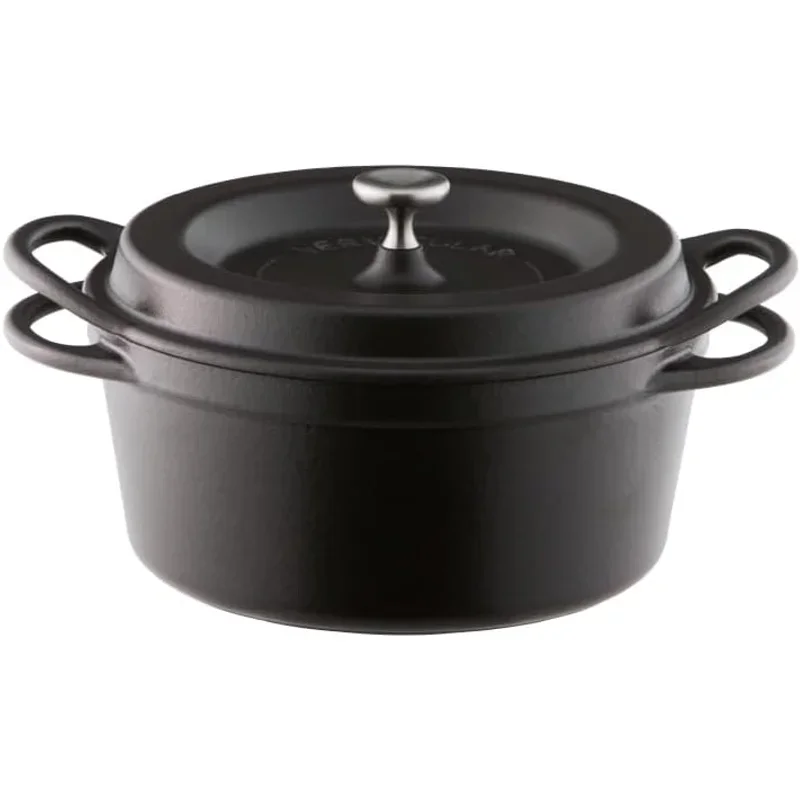
Compare Dutch Ovens
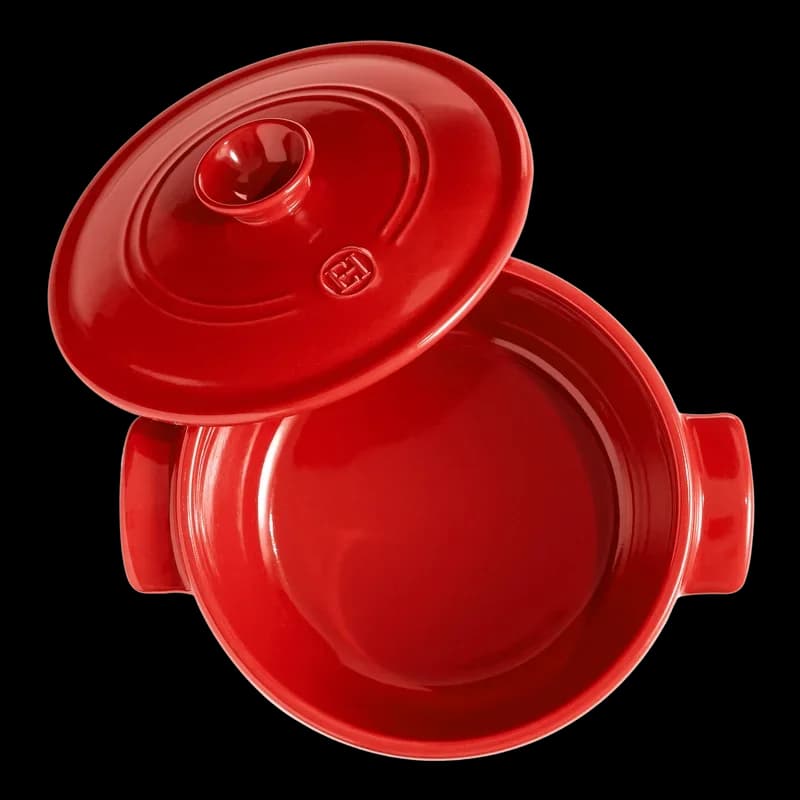
Emile Henry Flame Round Dutch Oven (5.5 qt) scores higher on safety - here's why.
The most important dimensions, side by side.
Emile Henry meets California's Prop 65 lead standard — the strictest in the US. Their manufacturing in France under EU food contact regulations means they are held to limits stricter than US FDA as a matter of law, not just brand preference.
EU regulations prohibit cadmium in food-contact ceramics — a standard even tighter than Prop 65. Emile Henry confirms compliance on their FAQ. Cadmium has historically been used in some enamel colorants; this is a clean bill of health.
Emile Henry's HR Flame ceramic is a fired glaze — no polymer coatings of any kind. It is PFAS-free by material science. The brand confirms this on their FAQ. The gap versus Caraway: no independent lab has published formal PFAS test results for Emile Henry.
Emile Henry's 10-year guarantee is the strongest warranty in this comparison — better than a standard limited lifetime warranty that can have more exclusions. For a $200 dutch oven, 10 years of coverage is meaningful protection.
There is no enamel on this pot. The cooking surface is bare cast iron pre-seasoned with vegetable oil. No enamel means no enamel lead leaching is possible -- which is actually better than a manufacturer's compliance claim.
Same as lead: no enamel coating means no cadmium leaching pathway from the cooking surface. The vegetable oil seasoning has no cadmium.
No synthetic coating anywhere on this pot -- just vegetable oil seasoning baked into the cast iron. PFAS-free by construction. Lodge confirms this on their product page. No independent lab has formally certified it, which is the only reason this isn't a 9 or 10.
Lodge's limited lifetime warranty applies to manufacturing defects. There is no enamel to chip -- if anything, bare cast iron is more durable in this sense.
482°F covers braising, roasting, soups, stews, and most oven applications without issue. If you bake Dutch oven sourdough, many recipes call for 500°F — that 18°F gap is a real but narrow limitation.
Cast iron lid with a loop handle -- there is no plastic or phenolic knob to degrade. You can use this under the broiler, on an open fire, or in a 700F wood-fired oven without any concern.
Emile Henry's HR ceramic is denser and thicker than standard ceramic, providing genuinely good heat retention. Better than the ceramic Caraway non-stick dutch oven, though not quite equivalent to full cast iron for marathon braises.
Bare cast iron has thicker walls than enameled versions (no enamel layer) which means slightly more thermal mass and arguably better heat retention. Professional outdoor cooking and braising use bare cast iron for exactly this reason.
8.8 lbs is the lightest a premium dutch oven gets. Full of a braise, you are lifting maybe 15-16 lbs — manageable for daily cooking. This makes Emile Henry the clear choice if weight is a primary concern.
At 13 lbs, this is heavier than the Le Creuset options at 11-11.5 lbs. Bare cast iron is denser than enameled. Plan for two-handed lifting.
At $200 you are paying for 170 years of French ceramic manufacturing expertise, EU food contact safety standards, and a 10-year guarantee. Competitive with Caraway Enameled Cast Iron ($195) for a lighter, different construction.
At $45, this is Lodge's most affordable Dutch oven. The same brand's enameled 6-qt is $70. The no-enamel option is actually the better safety choice for heavy-metal concerns, and it's the cheapest.
Everything you need to make the call - who each one is for, and who should skip it.
Go for it if you...
You want Prop 65 safety credentials in a significantly lighter dutch oven — at 8.8 lbs it handles daily use far more easily than cast iron alternatives.
You trust French manufacture under EU food contact regulations and value the 10-year guarantee.
You primarily braise, slow cook, or roast — the 482°F ceiling covers all of that without limitation.
You want the cleanest possible cooking surface with zero coating or enamel risk -- bare cast iron eliminates the entire enamel leaching question.
Your family cooks mostly non-acidic foods: searing meats, roasting vegetables, making cornbread, frying.
You're comfortable with cast iron care: hand washing, drying immediately, and occasional re-seasoning.
Budget is a genuine constraint and you want a Dutch oven that lasts for generations.
The main thing to know
Emile Henry has been making ceramic cookware in Marcigny, France since 1850 — and French manufacture under EU food contact regulations is genuinely stricter than US FDA for ceramic lead and cadmium limits. The result: Prop 65 compliant credentials earned through 170 years of European safety standards rather than US third-party testing. At 8.8 lbs it is the lightest premium dutch oven in this comparison, backed by a 10-year guarantee. Two honest limitations: the 482°F maximum is 18°F short of the 500°F benchmark many bakers need for Dutch oven bread; and Emile Henry has not published independent PFAS lab results (though fired ceramic glaze is inherently PFAS-free by material).
Bare cast iron is often overlooked for safety-focused families, but it has a real advantage: there is no enamel coating to leach anything. The entire enamel lead and cadmium question simply does not apply to this pot. What you are trading is convenience -- bare cast iron reacts with acidic foods, needs to be dried immediately, and requires occasional re-seasoning. If your family primarily cooks non-acidic foods and you are comfortable with cast iron care, this is a remarkable deal at $45.
Skip this if you...
You bake Dutch oven sourdough bread at 500°F — Emile Henry's 482°F ceiling is below what most recipes require.
You want published independent PFAS lab results — Emile Henry has not released these (though the ceramic material is inherently PFAS-free).
You want the most extensively third-party-tested option available — look at Caraway Enameled Cast Iron for published 200+ PFAS type results.
Your family regularly makes tomato sauces, wine braises, or other acidic dishes -- bare cast iron reacts with acid and can affect flavor and strip seasoning.
You want a low-maintenance pot that can handle anything without thought -- enameled Dutch ovens are more versatile day-to-day.
You are not interested in learning cast iron care and maintenance.
Neither of these quite what you're looking for?
I've reviewed all Dutch Ovens options at every price pointEvery Dutch Ovens in our database is scored using R3's deterministic scoring system - the same inputs always produce the same score. For this comparison, we evaluated Emile Henry and Lodge across 3 independent criteria: Safety (87%), Efficacy (12%), Usability (1%). No sponsored rankings. No paid placements.
Straight answers - no sponsored content, no filler.
I'd start with Emile Henry Emile Henry Flame Round Dutch Oven (5.5 qt) - it scored 9.2/10 overall in our scoring system. Safety is our top-weighted scoring pillar, followed by efficacy, and usability. Check which pillar matters most to your family and compare those specific scores.
R3 uses a deterministic scoring system - the same inputs always produce the same score. We evaluate each Dutch Ovens across Safety, Efficacy, Usability using independently verified data. No sponsored rankings. No paid placements. Every score is fully reproducible.
Not necessarily. The overall score reflects our weighted rubric, but your priorities may differ. If you care most about safety, compare the safety scores directly. If budget drives your decision, the prices tell a clearer story. The "right" pick is the one that matches what matters most to your family.
Not the right match? Explore these alternatives in the same category.