Compare Toaster Ovens
BALMUDA The Toaster scores higher on safety - here's why.
The most important dimensions, side by side.
The interior is galvalume steel — an aluminum-zinc alloy that avoids the toxic nonstick coatings found in some toaster ovens and sidesteps the lead-contamination concerns associated with galvanized steel. It is not stainless steel, though, and aluminum can migrate into food at sustained high temperatures, especially with tomato sauces, citrus, or other acidic ingredients.
Non-stick interior with no disclosure of coating type. Without transparency on whether this is PTFE or ceramic, we cannot rule out toxic off-gassing at broil temperatures.
BALMUDA has not made any PFAS-free statement for The Toaster. The galvalume interior does not use PTFE coatings by its material composition, but without a brand statement or independent test there is nothing for a buyer to rely on. Notably, BALMUDA's Kettle product does have a PFAS-free FAQ — The Toaster simply does not.
No PFAS assurance of any kind has been made by the brand for this product.
The baking tray your food rests on appears to be bare, uncoated aluminum — based on editorial reviews, since BALMUDA does not disclose this material officially. Uncoated aluminum can leach into acidic foods at levels that research suggests are a real concern for young children, particularly in a single meal. BALMUDA does sell a Noda Horo enamel tray as a separate accessory, and it is a worthwhile upgrade if you plan to cook anything acidic in this oven.
PTFE-coated tray in direct contact with food. PTFE degrades at oven temperatures, releasing fluorinated compounds onto food surfaces — the highest-risk tray material in the category.
Generous space for a compact toaster oven — fits four slices of bread with room to spare, or a small whole chicken. You are unlikely to feel constrained by the interior size for everyday toaster oven tasks.
Five cooking modes — Sandwich Bread, Artisan Bread, Pizza, Pastry, and Oven — each specifically tuned around BALMUDA's steam technology. These are meaningfully different settings, not just temperature presets with different names.
Five hundred degrees via Dual Heat Technology -- top and bottom elements firing together with rapid cyclonic air. This is the threshold for pizza stone use, high-heat searing, and maximum broiling. Only the Our Place matches this temperature in the comparison set.
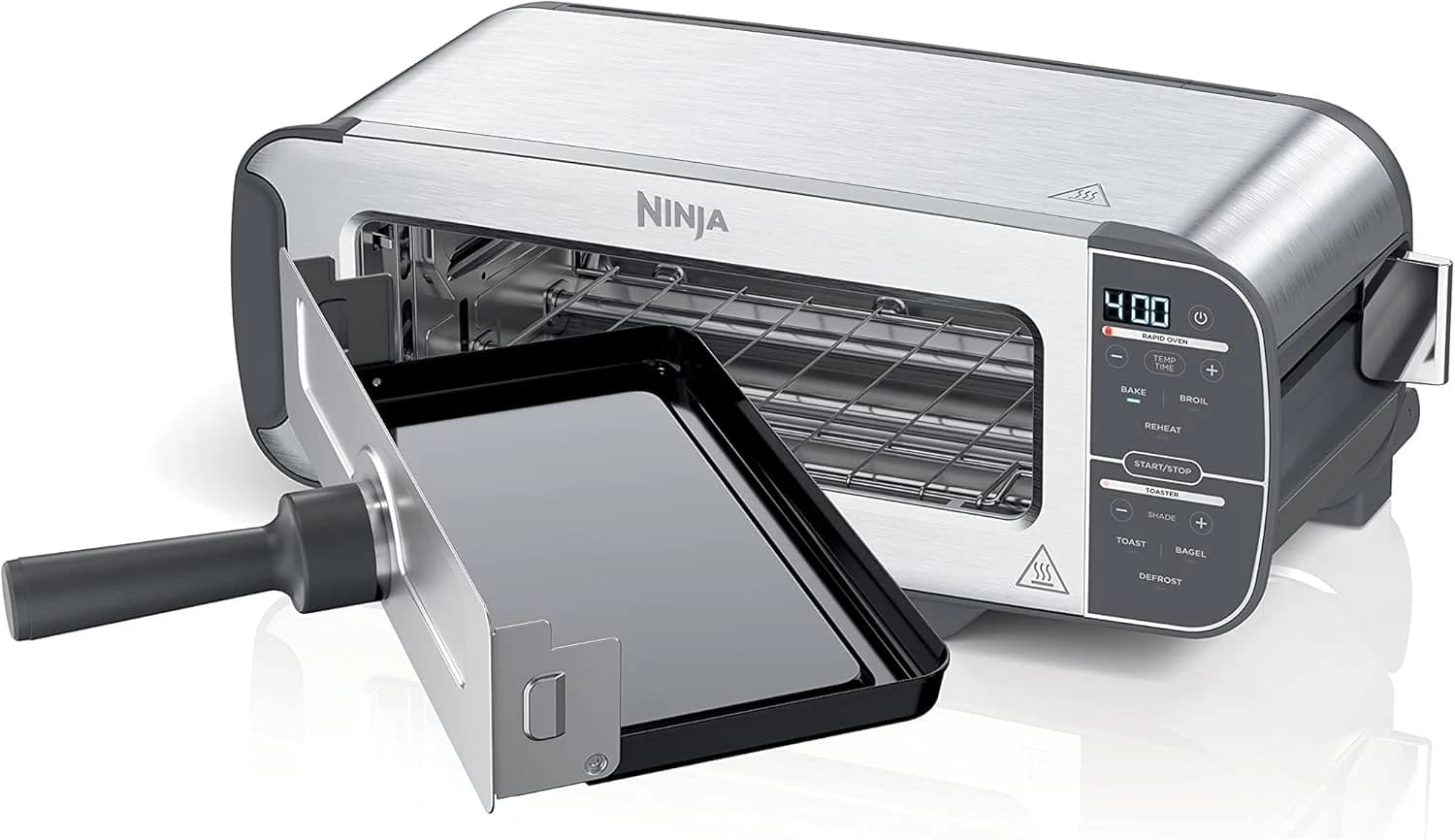
Rapid cyclonic air technology is Ninja's version of convection, and it's aggressive -- food crisps faster and more evenly than standard convection. The air fry function is one of 13 presets, and it works well.
The Smart Thermometer monitors food temperature via a probe -- useful for meat doneness, but it measures the food, not the oven. The oven cavity temperature accuracy itself is unverified by any independent lab. Ninja claims precision, but no one outside the company has confirmed it.
The crumb tray slides out cleanly for quick cleanup after each use. This is a small thing that makes a real difference in a toaster oven used daily — crumbs accumulate fast, and a tray you can actually remove means you will clean it.
Removable crumb tray with replacement parts available from Ninja. The flip-up storage design is a practical bonus for smaller kitchens -- fold it up against the backsplash when not in use.
Digital display with dial controls and 13 presets. Sear Crisp, Griddle, and separate Frozen Pizza / Fresh Pizza modes are functions most competitors don't offer. The interface is intuitive -- select a function, the oven suggests settings, you adjust and go.
At $299, you are paying a premium for BALMUDA's steam technology and design. From a safety-weighted value perspective, though, the price is steep for a product where the two most significant food-contact safety gaps remain unresolved.
At $270, the Ninja is $20 more than the Instant Omni Plus (91/100) and scores 53/100. The performance features are genuinely strong -- Dual Heat, 13 presets, Smart Thermometer -- but the unresolved safety questions make the price hard to justify when safer alternatives cost less. SlickDeals has tracked this oven at $190 on sale, which shifts the value equation if you can wait.
Everything you need to make the call - who each one is for, and who should skip it.
Go for it if you...
You prioritize exceptional toast and pastry results above all else and are willing to upgrade the baking tray separately.
You plan to buy the Noda Horo enamel tray accessory to replace the included aluminum tray before cooking acidic foods.
You value Japanese design craftsmanship and use this oven primarily for bread, not for acidic dishes or family meals.
You already own this oven and want to understand the material tradeoffs before committing to long-term daily use.
You want maximum cooking versatility -- 13 presets including Sear Crisp, Griddle, and Frozen Pizza modes that no other oven here offers.
You need 500°F for pizza stone use or high-heat searing and want Dual Heat Technology for faster preheating.
The Smart Thermometer for internal food temperature monitoring is important to your cooking style.
You've accepted the unspecified coating and lack of certification as known unknowns.
The main thing to know
The included baking tray appears to be bare aluminum — the material your food sits directly on — and BALMUDA has made no PFAS-free statement for this product. At $299, those are gaps we would not expect to find.
The Ninja SP351 is a powerhouse for cooking -- 500°F Dual Heat Technology, 13 presets, and a Smart Thermometer for internal food temperature monitoring. But the oven interior is labeled 'non-stick' without any disclosure of whether that's PTFE or ceramic. At 500°F max temperature, if the coating is PTFE, this oven heats to the exact temperature where PTFE begins to degrade. No UL/ETL certification was found either.
Skip this if you...
Verified food-contact material safety is your top priority — no PFAS certification exists for this product and the included baking tray is bare aluminum.
You want a toaster oven safe for cooking acidic foods like tomato-based dishes or citrus without purchasing aftermarket accessories.
You are buying a toaster oven for a household with young children and want independently verified clean materials from day one.
You need to know what coating touches your food -- Ninja won't disclose whether the interior is PTFE or ceramic. At 500°F, this matters more than on any other oven in the comparison.
You want independently certified electrical safety -- no UL or ETL mark was found for the SP351.
Safety transparency is a priority -- both the interior coating and safety certification are unresolved. The Instant Omni Plus at $20 less offers a porcelain-enamel interior and UL Listed certification.
Neither of these quite what you're looking for?
I've reviewed all Toaster Ovens options at every price pointEvery Toaster Ovens in our database is scored using R3's deterministic scoring system - the same inputs always produce the same score. For this comparison, we evaluated BALMUDA and Ninja across 3 independent criteria: Safety (86%), Efficacy (6%), Usability (3%). No sponsored rankings. No paid placements.
Straight answers - no sponsored content, no filler.
I'd start with BALMUDA BALMUDA The Toaster - it scored 4.4/10 overall in our scoring system. Safety is our top-weighted scoring pillar, followed by efficacy, and usability. Check which pillar matters most to your family and compare those specific scores.
R3 uses a deterministic scoring system - the same inputs always produce the same score. We evaluate each Toaster Ovens across Safety, Efficacy, Usability using independently verified data. No sponsored rankings. No paid placements. Every score is fully reproducible.
Not necessarily. The overall score reflects our weighted rubric, but your priorities may differ. If you care most about safety, compare the safety scores directly. If budget drives your decision, the prices tell a clearer story. The "right" pick is the one that matches what matters most to your family.
Not the right match? Explore these alternatives in the same category.