Compare Dutch Ovens
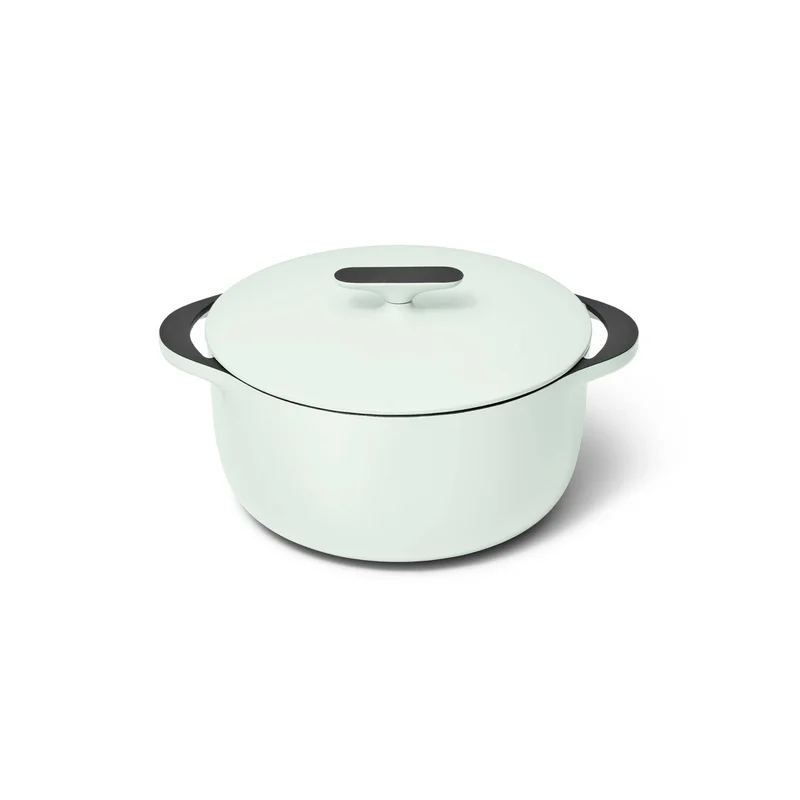
Caraway Enameled Cast Iron Dutch Oven scores higher on safety - here's why.
The most important dimensions, side by side.
Amazon Basics has published no lead-free certification, Prop 65 statement, or any other lead safety documentation for this pot. We literally cannot assess the risk.
Caraway's lead testing meets California's Prop 65 standard — roughly 10x stricter than baseline FDA limits. Results are independently verified and publicly available. This is the gold standard for lead safety in cookware.
Same as lead — zero cadmium documentation. Cadmium was historically used in red and yellow enamel colorants; without testing we have no way to assess whether this enamel is cadmium-free.
Cadmium was historically used in red and yellow enamel colorants. Caraway's 20+ heavy metal testing panel includes cadmium — verified clean by an independent lab.
Amazon Basics makes no PFAS-free claim. Traditional vitreous enamel on cast iron is inherently PFAS-free by material, but the brand has not confirmed this, and we cannot verify it independently.
Caraway tests for over 200 types of PFAS — far more than most brands even claim to check. Independent results are published. While vitreous enamel on cast iron is inherently PFAS-free by material, having the lab data to prove it is a meaningful differentiator.
No manufacturer warranty for enamel chipping. When the enamel chips — which it will eventually — you absorb the replacement cost. Every other dutch oven in this comparison has at least a limited warranty.
Caraway backs this cast iron dutch oven with a limited lifetime warranty — the same class of coverage you get from Le Creuset and Staub. If the enamel chips from a manufacturing defect, Caraway covers it.
500°F covers everything — Dutch oven bread baking, searing, braising, roasting. No temperature limitations for typical home cooking.
At 500°F, nothing is off the table — Dutch oven sourdough, searing followed by a low braise, high-heat roasts. No temperature ceiling for typical home cooking.
It is cast iron — it holds heat the way cast iron does. Good for long braises and slow cooking where consistent low heat matters.
Cast iron holds heat better than any other common cookware material. Once this pot is hot, it stays hot — perfect for the kind of long, slow, low-heat braises that are the dutch oven's signature use.
At 14.4 lbs empty, this is a heavy pot. When full of braised chicken or beef stew, you are moving real weight. Not unusual for cast iron, but it is a daily-use consideration.
At 13.4 lbs empty, this pot demands respect. Full of a Sunday braise, you are managing serious weight. This is the fundamental tradeoff of cast iron — unmatched cooking performance, real physical demands.
At $50 this is genuinely cheap for a cast iron dutch oven. The tradeoff is every safety metric scores at the bottom.
At $195 you get Caraway's full testing program applied to a genuine cast iron dutch oven. That is roughly half the price of Le Creuset with the same class of safety verification.
Everything you need to make the call - who each one is for, and who should skip it.
Go for it if you...
You need a functional cast iron dutch oven at the lowest possible price and accept the unknown safety profile.
You are buying a second pot for tasks like pasta water where enamel safety is less relevant.
You understand and accept that there is no documentation to back up chemical safety claims.
You want the most rigorously third-party-tested dutch oven in the category — Caraway tests more PFAS types and heavy metals than any competitor we evaluated.
You want genuine cast iron performance: excellent heat retention for long braises and 500°F oven capability for Dutch oven bread.
You are comfortable with 13.4 lbs and want a pot that will last a lifetime under a solid limited warranty.
The main thing to know
The Amazon Basics dutch oven does the physical job — it is cast iron, it holds heat, it handles 500°F. But Amazon Basics publishes absolutely no safety documentation: no lead disclosure, no cadmium disclosure, no PFAS claim, and no enamel chip warranty. In a category where heavy metals in enamel are a real and documented concern, total opacity is a significant flag. The $50 price reflects exactly what you are getting: function without any safety assurance.
Caraway's enameled cast iron dutch oven combines two things that are hard to find together: the most rigorously third-party-tested chemical safety profile in the category (200+ PFAS types, 20+ heavy metals, Prop 65 verified for both lead and cadmium) with genuine cast iron performance — excellent heat retention, 500°F oven capability, and a limited lifetime warranty. The honest tradeoff is weight: at 13.4 lbs, this is a heavy pot for daily family cooking. If you want safety verification without cast iron weight, the ceramic Caraway non-stick dutch oven is the lighter option, though it scores lower on heat retention.
Skip this if you...
You want any verified assurance about lead, cadmium, or PFAS in the enamel — this pot has none.
You expect an enamel chip warranty — Amazon Basics offers none.
You are cooking acidic foods like tomato sauce regularly, where enamel integrity and lead-free certification matter most.
You cook daily and need a lightweight option — at 13.4 lbs this is a physically demanding daily driver.
You are on a tight budget — at $195 there are cheaper cast iron options, though none with these safety credentials.
You want the lightest possible dutch oven — look at Emile Henry (8.8 lbs) or the ceramic Caraway non-stick version instead.
Neither of these quite what you're looking for?
I've reviewed all Dutch Ovens options at every price pointEvery Dutch Ovens in our database is scored using R3's deterministic scoring system - the same inputs always produce the same score. For this comparison, we evaluated Amazon Basics and Caraway across 3 independent criteria: Safety (87%), Efficacy (12%), Usability (1%). No sponsored rankings. No paid placements.
Straight answers - no sponsored content, no filler.
I'd start with Caraway Caraway Enameled Cast Iron Dutch Oven - it scored 9.9/10 overall in our scoring system. Safety is our top-weighted scoring pillar, followed by efficacy, and usability. Check which pillar matters most to your family and compare those specific scores.
R3 uses a deterministic scoring system - the same inputs always produce the same score. We evaluate each Dutch Ovens across Safety, Efficacy, Usability using independently verified data. No sponsored rankings. No paid placements. Every score is fully reproducible.
Not necessarily. The overall score reflects our weighted rubric, but your priorities may differ. If you care most about safety, compare the safety scores directly. If budget drives your decision, the prices tell a clearer story. The "right" pick is the one that matches what matters most to your family.
Not the right match? Explore these alternatives in the same category.