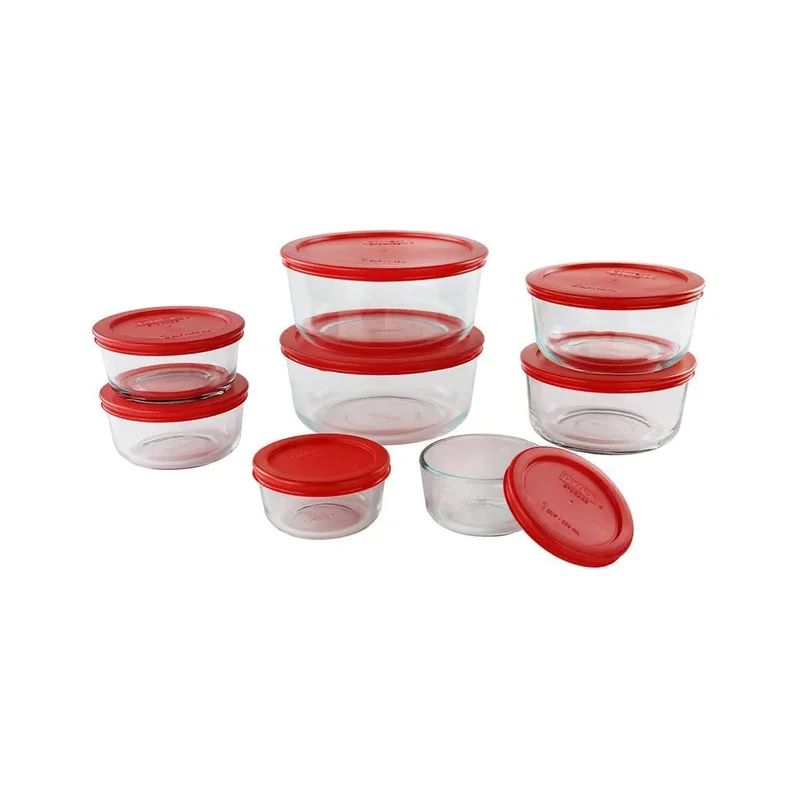
Key Specs
Container Material
Tempered soda-lime glass
Lid Material
BPA-free polypropylene (PP) plastic
Lid Seal Type
Press-fit (no locking mechanism)
Oven Safe Up To
425°F
Pyrex
#6 of 8 food storage containers tested
$37.99
What the product listing won't tell you
Know before you buy
Pyrex Simply Store gives you a genuinely safe glass container body at an unbeatable price — but the BPA-free polypropylene lids are a plastic food-contact surface, and the press-fit design means these will leak if you try to transport liquids.
You want glass containers for the fridge, oven, and microwave without paying a premium — $37.99 for 9 containers is hard to beat.
Pyrex
Pyrex Simply Store Glass Food Storage Containers (18-Piece Set)
Pyrex
Pyrex Simply Store Glass Food Storage Containers (18-Piece Set)
We may earn a commission. It doesn't affect our scores.
You mostly store solid foods at home and don't need a leak-proof seal for bags or transport.
You want containers that will never stain or absorb odors from tomato sauce, curry, or pungent foods.
You're comfortable with a plastic lid that you remove before microwaving.
You want the long-term option: the glass lasts decades, replacement lids are available, and you can keep the set going indefinitely.
You need leak-proof containers for packed lunches, meal prep transport, or carrying soups — press-fit lids will let liquid through.
You want lids with zero plastic food contact — consider Weck glass-lid jars or silicone container sets instead.
You need independently certified safety verification beyond FDA compliance — no LFGB, NSF, or PFAS lab test found.
Specs the product listing doesn't explain
What determines how well this performs its core job
What your food and family come into contact with every use
Noise, maintenance, and what happens if something goes wrong
Additional product details
8 criteria — open any layer to see exactly what we found
6
Safety
Mixed
6.9
Efficacy
Good
6.8
Usability
Good
Criteria
The container body is tempered glass — no plastic, no coating, nothing to chip or leach into your food. You can store tomato sauce, curry, or acidic leftovers without any flavor transfer or staining. The one limit: don't move glass directly from freezer to hot oven — let it warm up first.
The lids are BPA-free plastic — which is the minimum standard, not a premium feature. Pyrex hasn't confirmed BPS-free or phthalate-free status. If you store containers upright, plastic-to-food contact is minimal. If you stack them or store on their side, the lid is touching your food.
Pyrex's only chemical safety claim for this set is 'BPA-free lids.' No information on BPS, phthalates, or other plastic additives in the lid material. The glass container body doesn't need these claims — it's inherently free of all plasticizers — but the lid transparency is minimal.
R3 verdict
The glass containers are the safest food-contact surface in this category — soda-lime glass is chemically inert, non-porous, and won't absorb odors, flavors, or stains from any food. The weak point is the BPA-free polypropylene lid: it's a plastic surface that makes direct contact with food when containers are stored on their side or stacked lid-down, and Pyrex's chemical disclosure is limited to a single BPA-free claim.
Criteria
Pyrex meets FDA food-contact standards — the regulatory baseline in the US. There's no independent lab that has tested this set for PFAS, heavy metals, or plastic additives. For the glass containers, that's fine — glass is inherently inert. For the plastic lids, you're taking Pyrex's word on the BPA-free claim.
R3 verdict
Pyrex's safety credibility comes from 80+ years of use and FDA regulatory compliance — not from modern third-party lab testing. No LFGB certification, no NSF/ANSI 2, and no T1 PFAS lab test found for either the glass or the lid materials.
For the glass body, this is a labeling gap, not a safety issue — glass can't contain PFAS. For the plastic lids, the absence of independent verification means you're trusting Pyrex's BPA-free claim without outside confirmation.
Criteria
These lids use simple friction to stay on — no clips, no snaps, no gasket. For solid leftovers in the fridge, they work. For anything wet or liquid, or for carrying containers in a bag, they will leak. If you need a leak-proof lid, look at Snapware Total Solution or Rubbermaid Brilliance.
You can store tomato sauce, curry, or strongly flavored foods without any permanent staining or odor transfer. Rinse the container and it comes out clean. Plastic containers stain orange from tomatoes and absorb garlic smells — this set won't.
R3 verdict
Criteria
Load the containers and lids anywhere in the dishwasher — no restrictions. Both pieces come out clean with no warping, cracking, or seal damage. As low-maintenance as food storage gets.
R3 verdict
Both glass containers and plastic lids are fully dishwasher safe — no special handling required. This is a clean upgrade from the prior version where lids were restricted to top-rack only. Full dishwasher compatibility on both pieces makes daily cleanup completely hassle-free.
Criteria
Two-year warranty is reasonable for the price. The glass itself will outlast the warranty by decades — it's the lids that wear out. Pyrex sells replacement lids on Amazon, so when your lids warp or crack at year 4 or 5, you can replace them for a few dollars instead of buying a whole new set.
R3 verdict
The glass containers in this set are the kind of thing people inherit from their parents. The lids aren't.
PP plastic lids typically degrade in 3-5 years of daily use — the press-fit weakens, the plastic clouds or cracks. The 2-year warranty is reasonable for a budget glass set, and Pyrex sells replacement lids separately on Amazon, which means you can keep the glass containers going indefinitely by replacing just the lids.
Criteria
The glass containers go in the microwave — the lids don't. You need to remove the lid every time you reheat, which means no cover for splatter. A damp paper towel on top solves the splatter problem. It's a minor step you'll do hundreds of times per year.
Glass containers and lids go straight in the freezer — no special treatment needed. Ideal for batch cooking and meal prep. Just let frozen glass warm to room temperature before putting in a hot oven.
Criteria
These containers are designed for home use — fridge, oven, microwave, dishwasher. They're not ideal for a work bag or a child's lunchbox. Glass is heavier than plastic, and if it hits a hard floor, it breaks. Keep this set at home and use stainless steel or silicone containers for on-the-go use.
R3 verdict
Glass is heavy and it shatters — those are the only two things to know about portability. For home use, weight is a minor issue and breakage isn't a concern on your kitchen counter.
For packed lunches or work bags, both become real problems: you're adding meaningful weight to a bag, and dropping the container means broken glass. The press-fit lid provides no leak protection during transport, which compounds the portability limitation.
Criteria
You get 9 glass containers for about $4.22 each — competitive pricing for tempered glass food storage. Strong value without being exceptional: you're trading premium lid design and certifications for a lower price.
R3 verdict
At $37.99 for 9 glass containers, Pyrex Simply Store delivers strong value for the category. The glass body will last decades.
The lids are the perishable part — and replacement lids are available. The value calculus here is simple: you get the superior material (glass) at a competitive price.
Already have an account? Log in
Verified retailer — current pricing
Starting price
$37.99
We earn a small commission on purchases. It never influences our scores — R3 is funded by readers, not brands.
Alternatives that address specific trade-offs
Why this matters: Pyrex's safety credibility comes from 80+ years of use and FDA regulatory compliance — not from modern third-party lab testing. No LFGB certification,
Stasher
Scores 6.0/10 on third-party certification & verification vs 4.0 here
Didn't find the food storage container you need?
See all food storage containers we reviewed#6 of 8 food storage containers reviewed
No BPS-free or phthalate-free disclosures found. The glass body earns a floor score for chemical disclosure — the material itself is inherently inert, but the lid chemical profile is underreported.
The glass does its job perfectly on stain and odor resistance — there's no food that will permanently affect these containers, and they'll look as clean at year 10 as they do on day one. The weak point is the lid: press-fit friction lids are not airtight and are not leak-proof.
For refrigerator storage of solid foods, they work fine. Don't put these in a bag with soup or carry them sideways — the lid will let liquid through.
The glass does its job perfectly on stain and odor resistance — there's no food that will permanently affect these containers, and they'll look as clean at year 10 as they do on day one. The weak point is the lid: press-fit friction lids are not airtight and are not leak-proof.
For refrigerator storage of solid foods, they work fine. Don't put these in a bag with soup or carry them sideways — the lid will let liquid through.
Glass containers go in an oven preheated to 425°F — enough for casseroles, reheating pasta bakes, roasting vegetables, and most baking tasks. This isn't a broiler-safe pan, so don't put it under the broiler element. Remove lids before any oven use.
R3 verdict
Strong thermal versatility overall — you get freezer, fridge, microwave, and oven in one container. The 425°F oven limit covers the vast majority of home cooking.
The one friction point is microwave use: you have to remove the lid every time (plastic lids can't go in the microwave), which means no splatter protection. A minor daily inconvenience, but worth knowing before you buy.
R3 verdict
Strong thermal versatility overall — you get freezer, fridge, microwave, and oven in one container. The 425°F oven limit covers the vast majority of home cooking.
The one friction point is microwave use: you have to remove the lid every time (plastic lids can't go in the microwave), which means no splatter protection. A minor daily inconvenience, but worth knowing before you buy.