Compare Toaster Ovens
Which scores higher on safety? R3 breaks it down.
The most important dimensions, side by side.
Oster says 'non-stick interior,' but hasn't specified what the coating actually is — ceramic, PTFE, or something else. At the temperatures a toaster oven routinely reaches during broiling, that distinction matters. We can't rule out PTFE from what's disclosed.
The interior walls have a nonstick coating — we just do not know what kind. Panasonic does not disclose it, and the brand's own newer models have moved to PFAS-free interiors, which raises fair questions about what was in the older formula.
Oster has made zero PFAS-free claims anywhere — no brand statement, no independent lab test, no certification. On a product with an unspecified nonstick interior, that's the most concerning position for families who want any level of chemical safety assurance.
Panasonic has made no promise on this model about PFAS — a class of chemicals that some families are actively trying to avoid in cookware. Their newer FlashXpress line already advertises a PFAS-free interior, so the absence here is conspicuous, not incidental.
The included baking tray is bare, uncoated aluminum. When you cook acidic foods — tomatoes, citrus, vinegar-based marinades — aluminum leaches into the food. European food safety research has flagged this as a particular concern for young children. We're sourcing this from retailer descriptions rather than a brand-confirmed spec, but the information is consistent across multiple listings.
The baking tray is stainless steel, which is a safe material for food contact. We are working from editorial reviews here rather than brand confirmation, and the exact steel grade has not been disclosed — so we cannot call it fully verified.
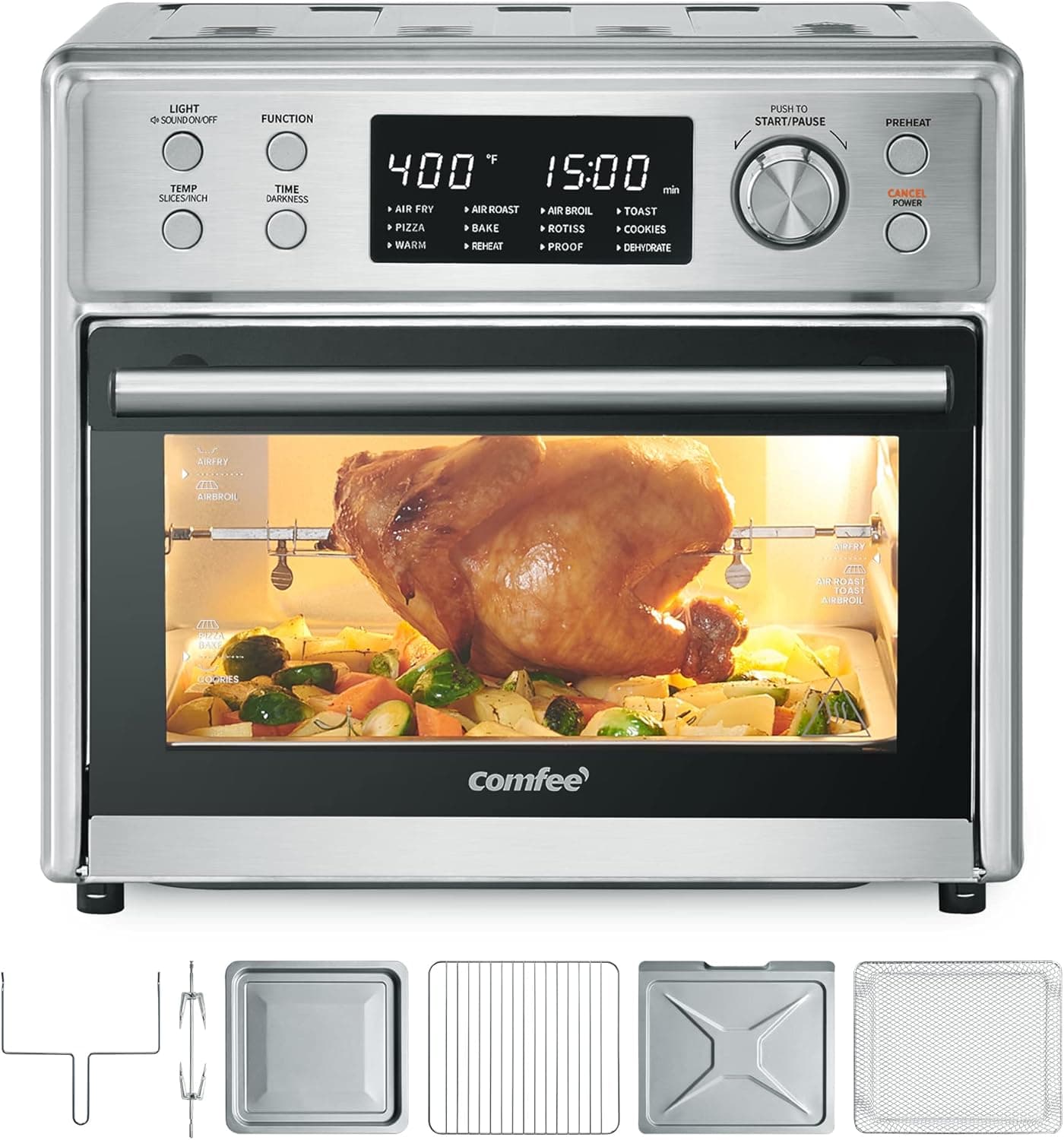
Twenty-six quarts is the largest capacity we've seen in this category — it fits a small whole chicken and handles full sheet-pan meals. If cooking volume matters to you, this oven genuinely delivers.
This oven comfortably fits four slices of toast or a 9-inch pizza. It is not designed for large meals — whole chickens, sheet-pan dinners, or full-size baking dishes are off the table.
Ten cooking modes — air fry, bake, broil, roast, dehydrate, pizza, defrost, tender roast, toast, and warm — is a full-featured lineup that handles nearly any cooking task you'd bring to a countertop oven.
Three core cooking modes cover everyday tasks well. The six auto-cook presets handle common frozen foods with one button, but there is no broil, air fry, or convection setting for more demanding recipes.
The crumb tray slides out cleanly for washing. It's confirmed in the product manual — the manual labels it as both a crumb tray and a cookie sheet, so it doubles as a small baking accessory.
The crumb tray slides out from the bottom for quick cleaning. That means no tilting the oven over the sink or digging out debris with a brush — just pull, rinse, and slide back in.
The sticker price looks reasonable. The problem is that R3 measures what you're paying per point of actual safety and performance — and with near-floor safety scores, that math doesn't hold up. There are safer options in a similar price range.
The $150 price tag is reasonable for a well-made toaster oven — but the unresolved questions about interior coating materials make it a tough sell when PFAS-free alternatives exist at the same price point, including from Panasonic themselves.
Everything you need to make the call - who each one is for, and who should skip it.
Go for it if you...
You prioritize cooking performance and capacity over material safety, and you primarily cook non-acidic foods.
You need a large countertop oven with air fry and dehydrate capability at a budget-friendly price.
You already own lined bakeware and plan to avoid using the included aluminum tray for acidic dishes.
You're equipping a rental kitchen or a space where premium material safety is not the primary criterion.
You already own one and use it primarily for toast on the stainless steel rack, not extended cooking that saturates the interior walls.
You want a compact, preheat-free oven for frozen breakfast foods and quick reheating — this is genuinely excellent at that job.
You are replacing a broken unit and want the same model's reliability while planning to upgrade to a PFAS-free oven in the next cycle.
The main thing to know
The interior coating type is completely undisclosed — Oster says 'non-stick' but won't specify whether it's PTFE, ceramic, or something else — and there's no PFAS-free claim anywhere. The bare aluminum baking tray adds a separate food-contact concern for acidic cooking.
The interior cavity walls use an unspecified nonstick coating with no PFAS-free claim — and Panasonic's own newer models have already addressed this with a clean-material interior. That gap makes it hard to recommend this oven for families who are paying attention to what their food cooks near.
Skip this if you...
You have young children and want confidence that the surfaces your food touches are free of unknown coatings or chemical concerns.
You want any level of PFAS-free assurance — Oster makes no such claim on this product.
You cook acidic foods regularly and plan to use the included baking tray.
You're comparing options and want the best safety-per-dollar at this price point — safer alternatives exist.
You want to know exactly what coating is on the surfaces your food cooks near — this oven does not disclose that.
You are shopping new and have $150 to spend, because the PFAS-free Panasonic NB-G200P is available at a similar price from the same brand.
You cook acidic or fatty foods that sit in direct contact with the interior walls for extended periods.
Neither of these quite what you're looking for?
I've reviewed all Toaster Ovens options at every price pointEvery Toaster Ovens in our database is scored using R3's deterministic scoring system - the same inputs always produce the same score. For this comparison, we evaluated Oster and Panasonic across 3 independent criteria: Safety (86%), Efficacy (6%), Usability (3%). No sponsored rankings. No paid placements.
Straight answers - no sponsored content, no filler.
Both scored close to 2.6/10, so the better choice depends on your priorities. Safety is our top-weighted scoring pillar, followed by efficacy, and usability. Check which pillar matters most to your family and compare those specific scores.
R3 uses a deterministic scoring system - the same inputs always produce the same score. We evaluate each Toaster Ovens across Safety, Efficacy, Usability using independently verified data. No sponsored rankings. No paid placements. Every score is fully reproducible.
Not necessarily. The overall score reflects our weighted rubric, but your priorities may differ. If you care most about safety, compare the safety scores directly. If budget drives your decision, the prices tell a clearer story. The "right" pick is the one that matches what matters most to your family.
Not the right match? Explore these alternatives in the same category.