Compare Toaster Ovens
Panasonic FlashXpress Toaster Oven scores higher on safety - here's why.
The most important dimensions, side by side.
Non-stick interior with no disclosure of coating type. Without transparency on whether this is PTFE or ceramic, we cannot rule out toxic off-gassing at broil temperatures.
The interior walls have a nonstick coating — we just do not know what kind. Panasonic does not disclose it, and the brand's own newer models have moved to PFAS-free interiors, which raises fair questions about what was in the older formula.
No PFAS assurance of any kind has been made by the brand for this product.
Panasonic has made no promise on this model about PFAS — a class of chemicals that some families are actively trying to avoid in cookware. Their newer FlashXpress line already advertises a PFAS-free interior, so the absence here is conspicuous, not incidental.
PTFE-coated tray in direct contact with food. PTFE degrades at oven temperatures, releasing fluorinated compounds onto food surfaces — the highest-risk tray material in the category.
The baking tray is stainless steel, which is a safe material for food contact. We are working from editorial reviews here rather than brand confirmation, and the exact steel grade has not been disclosed — so we cannot call it fully verified.
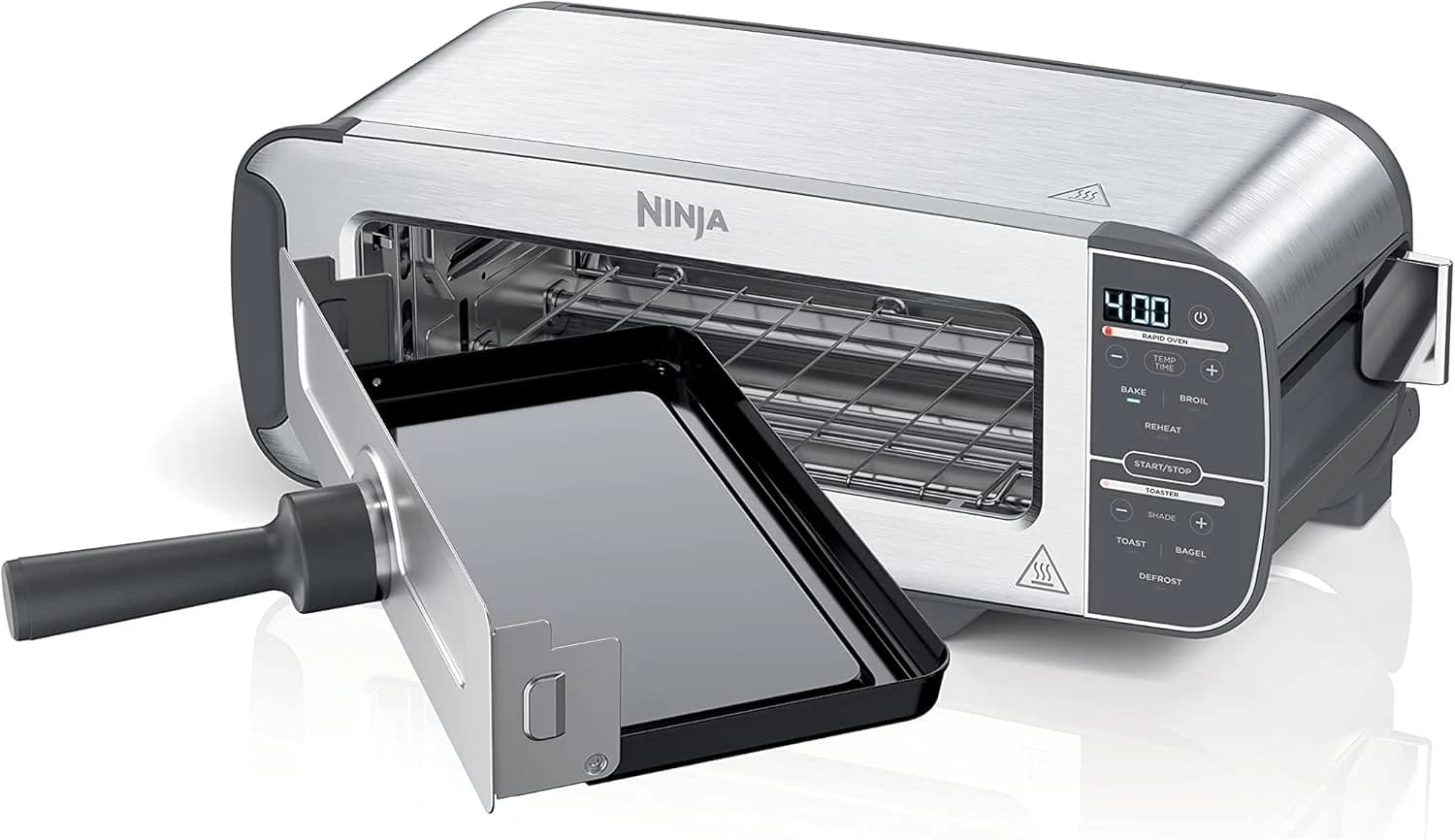
Five hundred degrees via Dual Heat Technology -- top and bottom elements firing together with rapid cyclonic air. This is the threshold for pizza stone use, high-heat searing, and maximum broiling. Only the Our Place matches this temperature in the comparison set.
Rapid cyclonic air technology is Ninja's version of convection, and it's aggressive -- food crisps faster and more evenly than standard convection. The air fry function is one of 13 presets, and it works well.
The Smart Thermometer monitors food temperature via a probe -- useful for meat doneness, but it measures the food, not the oven. The oven cavity temperature accuracy itself is unverified by any independent lab. Ninja claims precision, but no one outside the company has confirmed it.
This oven comfortably fits four slices of toast or a 9-inch pizza. It is not designed for large meals — whole chickens, sheet-pan dinners, or full-size baking dishes are off the table.
Three core cooking modes cover everyday tasks well. The six auto-cook presets handle common frozen foods with one button, but there is no broil, air fry, or convection setting for more demanding recipes.
Removable crumb tray with replacement parts available from Ninja. The flip-up storage design is a practical bonus for smaller kitchens -- fold it up against the backsplash when not in use.
The crumb tray slides out from the bottom for quick cleaning. That means no tilting the oven over the sink or digging out debris with a brush — just pull, rinse, and slide back in.
Digital display with dial controls and 13 presets. Sear Crisp, Griddle, and separate Frozen Pizza / Fresh Pizza modes are functions most competitors don't offer. The interface is intuitive -- select a function, the oven suggests settings, you adjust and go.
At $270, the Ninja is $20 more than the Instant Omni Plus (91/100) and scores 53/100. The performance features are genuinely strong -- Dual Heat, 13 presets, Smart Thermometer -- but the unresolved safety questions make the price hard to justify when safer alternatives cost less. SlickDeals has tracked this oven at $190 on sale, which shifts the value equation if you can wait.
The $150 price tag is reasonable for a well-made toaster oven — but the unresolved questions about interior coating materials make it a tough sell when PFAS-free alternatives exist at the same price point, including from Panasonic themselves.
Everything you need to make the call - who each one is for, and who should skip it.
Go for it if you...
You want maximum cooking versatility -- 13 presets including Sear Crisp, Griddle, and Frozen Pizza modes that no other oven here offers.
You need 500°F for pizza stone use or high-heat searing and want Dual Heat Technology for faster preheating.
The Smart Thermometer for internal food temperature monitoring is important to your cooking style.
You've accepted the unspecified coating and lack of certification as known unknowns.
You already own one and use it primarily for toast on the stainless steel rack, not extended cooking that saturates the interior walls.
You want a compact, preheat-free oven for frozen breakfast foods and quick reheating — this is genuinely excellent at that job.
You are replacing a broken unit and want the same model's reliability while planning to upgrade to a PFAS-free oven in the next cycle.
The main thing to know
The Ninja SP351 is a powerhouse for cooking -- 500°F Dual Heat Technology, 13 presets, and a Smart Thermometer for internal food temperature monitoring. But the oven interior is labeled 'non-stick' without any disclosure of whether that's PTFE or ceramic. At 500°F max temperature, if the coating is PTFE, this oven heats to the exact temperature where PTFE begins to degrade. No UL/ETL certification was found either.
The interior cavity walls use an unspecified nonstick coating with no PFAS-free claim — and Panasonic's own newer models have already addressed this with a clean-material interior. That gap makes it hard to recommend this oven for families who are paying attention to what their food cooks near.
Skip this if you...
You need to know what coating touches your food -- Ninja won't disclose whether the interior is PTFE or ceramic. At 500°F, this matters more than on any other oven in the comparison.
You want independently certified electrical safety -- no UL or ETL mark was found for the SP351.
Safety transparency is a priority -- both the interior coating and safety certification are unresolved. The Instant Omni Plus at $20 less offers a porcelain-enamel interior and UL Listed certification.
You want to know exactly what coating is on the surfaces your food cooks near — this oven does not disclose that.
You are shopping new and have $150 to spend, because the PFAS-free Panasonic NB-G200P is available at a similar price from the same brand.
You cook acidic or fatty foods that sit in direct contact with the interior walls for extended periods.
Neither of these quite what you're looking for?
I've reviewed all Toaster Ovens options at every price pointEvery Toaster Ovens in our database is scored using R3's deterministic scoring system - the same inputs always produce the same score. For this comparison, we evaluated Ninja and Panasonic across 3 independent criteria: Safety (68%), Efficacy (29%), Usability (3%). No sponsored rankings. No paid placements.
Straight answers - no sponsored content, no filler.
I'd start with Panasonic Panasonic FlashXpress Toaster Oven - it scored 2.9/10 overall in our scoring system. Safety is our top-weighted scoring pillar, followed by efficacy, and usability. Check which pillar matters most to your family and compare those specific scores.
R3 uses a deterministic scoring system - the same inputs always produce the same score. We evaluate each Toaster Ovens across Safety, Efficacy, Usability using independently verified data. No sponsored rankings. No paid placements. Every score is fully reproducible.
Not necessarily. The overall score reflects our weighted rubric, but your priorities may differ. If you care most about safety, compare the safety scores directly. If budget drives your decision, the prices tell a clearer story. The "right" pick is the one that matches what matters most to your family.
Not the right match? Explore these alternatives in the same category.