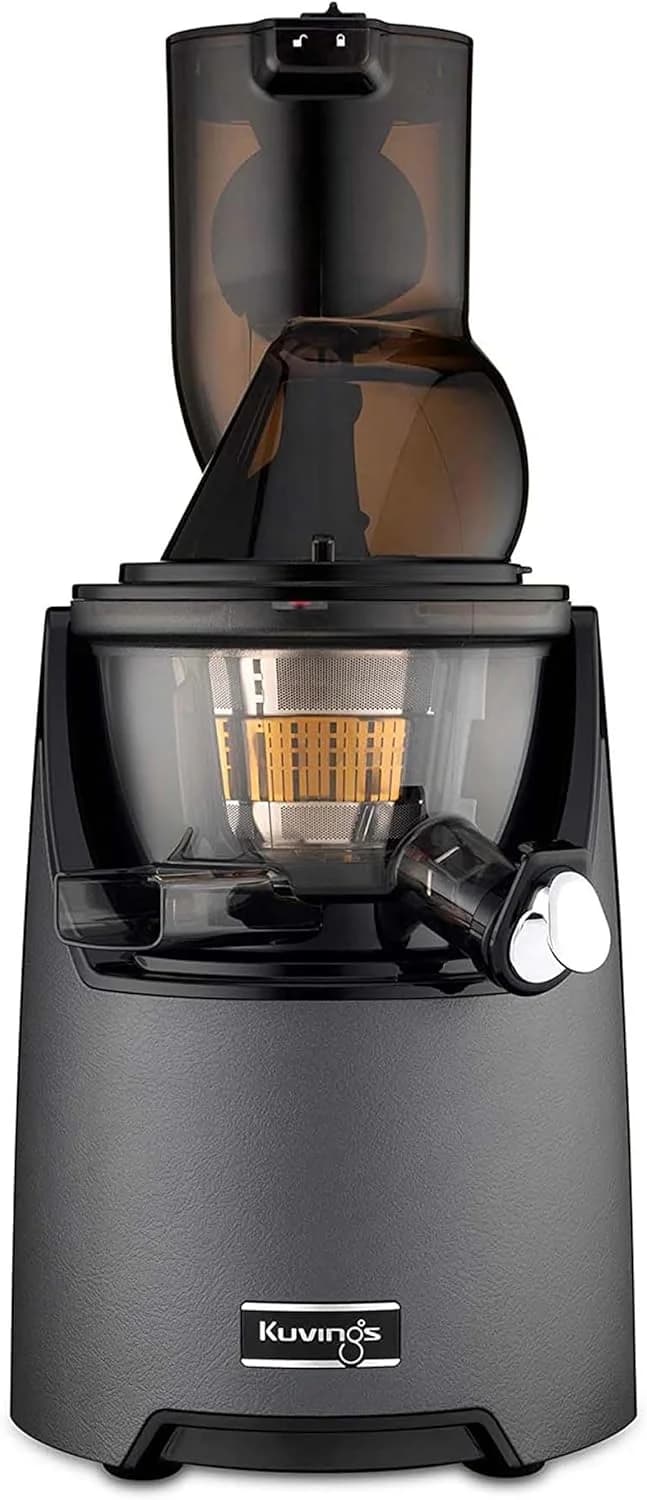
Compare Juicers
Citrus Press Pro 800CPXL scores higher on safety - here's why.
The most important dimensions, side by side.
The pressing surfaces are food-grade stainless steel -- non-reactive, durable, and one of the safest materials for food contact.
The filter basket where produce is shredded is stainless steel -- a safe, non-reactive surface. However, Breville does not specify the exact grade of steel used.
Your juice collects in a stainless steel container -- completely inert with zero chemical leaching risk, even with acidic citrus juice.
Your juice collects in a plastic container of unknown type. Breville does not disclose what this plastic is made of, which is concerning for acidic juice that sits in direct contact with the material.
Confirmed BPA-free. The all-metal construction means BPA was never a concern to begin with.
Breville has not stated whether this juicer's plastic parts are BPA-free. Without any disclosure, we cannot assess BPA risk.
No PFAS-containing materials anywhere. Stainless steel construction eliminates the need for any fluoropolymer coatings.
Breville has not addressed whether this product contains PFAS. For a product with plastic food-contact surfaces, this is a notable omission.
Breville publishes specific material grades for every food-contact component -- you know exactly what your juice touches.
Breville mentions stainless steel for the filter but leaves the plastic components unidentified. This partial disclosure is a common industry pattern but falls short of what safety-conscious families need.
No independent lab has tested this juicer's stainless steel components for heavy metal contamination. This is a category-wide gap, not specific to Breville.
No independent lab has tested this product for heavy metal content in its food-contact surfaces.
This is a dedicated citrus press -- it extracts orange, grapefruit, and lemon juice beautifully but cannot handle any other produce type.
Centrifugal extraction is the fastest method but generates the most heat, destroying some vitamins and enzymes. Not effective for leafy greens like kale or spinach.
The 110W motor provides plenty of pressing force for citrus. It's designed for lever-press operation, not high-speed extraction.
The 700W motor handles hard fruits and vegetables without issue. Apples, carrots, and beets are processed quickly.
Citrus presses use direct pressure rather than spinning blades, so RPM isn't a relevant measurement for this type of juicer.
At 14,000 RPM -- the highest speed in this comparison -- this juicer generates the most heat during extraction. Your juice oxidizes almost immediately and should be consumed right away.
Two interchangeable filters let you choose between pulpy or smooth juice -- swap them in seconds depending on your preference.
One fixed strainer with no pulp adjustment option. You get whatever pulp level the machine produces.
No noise measurement is available. Citrus presses are generally quieter than centrifugal juicers, but we don't have a confirmed number.
No noise measurement is available. Like all centrifugal juicers, expect loud operation -- likely too noisy for open-plan kitchens during quiet hours.
All removable parts go right in the dishwasher -- no hand-scrubbing required after your morning juice.
All removable parts are dishwasher safe -- a major convenience for daily juicing routines.
Four parts to take apart -- quick disassembly that takes under a minute.
Five parts to take apart -- simple enough for daily use without frustration.
At just 7.6 inches tall, this fits under any standard kitchen cabinet. It can live permanently on your counter without taking up visual space.
At 15.7 inches, this is slightly more compact than the JE98XL but still borderline for under-cabinet placement. Measure your clearance.
A 1-year warranty is the industry minimum. For a $251 appliance from a premium brand, you might expect longer coverage.
One year of warranty is the industry minimum. For an $80 appliance this is expected, but it does not inspire long-term confidence.
At $251, this is a mid-premium price for a citrus-only press. The all-stainless construction justifies the cost if citrus is your primary juice.
At $80, this is the cheapest juicer in the comparison. The low price is appealing, but the undisclosed plastic materials and poor nutrient retention mean you are trading transparency and quality for affordability.
Everything you need to make the call - who each one is for, and who should skip it.
Go for it if you...
Fresh orange, grapefruit, or lemon juice is a daily ritual in your household.
Zero plastic contact with your juice is a non-negotiable priority for your family.
You want a compact countertop appliance that fits under any cabinet at just 7.6 inches tall.
Easy cleanup matters -- dishwasher-safe parts and simple 4-piece disassembly.
You want the absolute cheapest way to start juicing and plan to drink your juice immediately.
Material transparency is not a priority and you are comfortable with unspecified plastic food-contact surfaces.
You need a compact, dishwasher-safe juicer for occasional use rather than daily juicing.
Speed matters more than nutrient retention -- you want juice in seconds, not minutes.
The main thing to know
This is a citrus-only press -- it cannot juice vegetables, leafy greens, or non-citrus fruits. If you need a versatile juicer, this isn't it, no matter how safe the materials are.
This juicer has the same undisclosed plastic container as its larger sibling the JE98XL, plus the highest RPM (14,000) in the comparison -- meaning both material safety and juice quality are at the bottom of the pack.
Skip this if you...
You want to juice vegetables, leafy greens, or non-citrus fruits -- this press physically cannot do it.
A 1-year warranty on a $251 appliance feels insufficient for your comfort level.
You need a single juicer that handles everything from carrots to celery to oranges.
You care about what materials your food touches -- Breville does not disclose the plastic type, BPA status, or PFAS status.
You want to store juice for later -- at 14,000 RPM, the juice oxidizes almost immediately.
Nutrient retention is important to your family -- centrifugal extraction at this speed destroys the most vitamins and enzymes of any method.
Neither of these quite what you're looking for?
I've reviewed all Juicers options at every price pointEvery Juicers in our database is scored using R3's deterministic scoring system - the same inputs always produce the same score. For this comparison, we evaluated Breville and Breville across 3 independent criteria: Safety (87%), Efficacy (9%), Usability (4%). No sponsored rankings. No paid placements.
Straight answers - no sponsored content, no filler.
I'd start with Breville Citrus Press Pro 800CPXL - it scored 8.3/10 overall in our scoring system. Safety is our top-weighted scoring pillar, followed by efficacy, and usability. Check which pillar matters most to your family and compare those specific scores.
R3 uses a deterministic scoring system - the same inputs always produce the same score. We evaluate each Juicers across Safety, Efficacy, Usability using independently verified data. No sponsored rankings. No paid placements. Every score is fully reproducible.
Not necessarily. The overall score reflects our weighted rubric, but your priorities may differ. If you care most about safety, compare the safety scores directly. If budget drives your decision, the prices tell a clearer story. The "right" pick is the one that matches what matters most to your family.
Not the right match? Explore these alternatives in the same category.