Compare Toaster Ovens
BLACK+DECKER 4-Slice Toaster Oven scores higher on safety - here's why.
The most important dimensions, side by side.
The oven's interior cavity has a zinc coating that independent safety researchers have flagged for potential lead contamination risk when used at high temperatures. This is worth knowing if you regularly bake or broil — the walls are what your food's steam and drippings interact with most. We're working from an independent reviewer's physical assessment here, not the brand's own disclosure.
Oster says 'non-stick interior,' but hasn't specified what the coating actually is — ceramic, PTFE, or something else. At the temperatures a toaster oven routinely reaches during broiling, that distinction matters. We can't rule out PTFE from what's disclosed.
BLACK+DECKER doesn't make any chemical-safety claims for this oven — no PFAS-free statement, no independent testing, nothing. The stainless steel accessories are inherently free of these chemicals by material composition, but the brand provides no formal assurance for any surface. For families who want that confirmation in writing, it simply isn't available here.
Oster has made zero PFAS-free claims anywhere — no brand statement, no independent lab test, no certification. On a product with an unspecified nonstick interior, that's the most concerning position for families who want any level of chemical safety assurance.
The baking tray where your food sits appears to be stainless steel — a non-reactive, coating-free surface that's genuinely good for food contact. The one gap is that the brand hasn't published which grade of stainless it is, so we can't confirm it's food-grade certified stainless. We're working from an independent reviewer's hands-on assessment.
The included baking tray is bare, uncoated aluminum. When you cook acidic foods — tomatoes, citrus, vinegar-based marinades — aluminum leaches into the food. European food safety research has flagged this as a particular concern for young children. We're sourcing this from retailer descriptions rather than a brand-confirmed spec, but the information is consistent across multiple listings.
The interior fits a 9-inch pizza, four slices of toast, or a small casserole — plenty of room for a couple or a small family cooking light meals. It won't fit a whole chicken, but for everyday toaster oven use that's not a realistic ask at this size. Note that this measurement comes from an independent reviewer's conversion, not a spec directly from the brand.
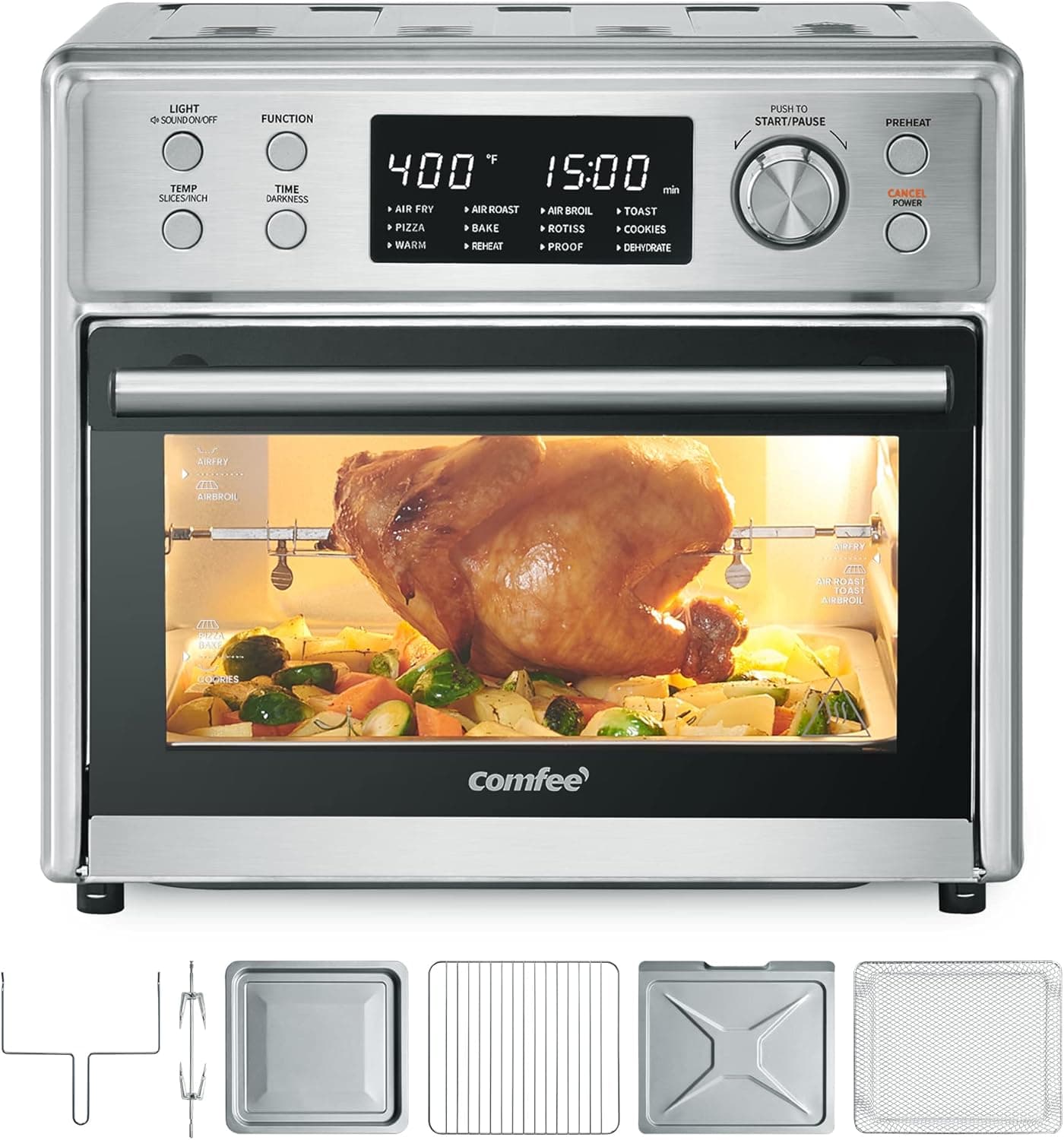
Twenty-six quarts is the largest capacity we've seen in this category — it fits a small whole chicken and handles full sheet-pan meals. If cooking volume matters to you, this oven genuinely delivers.
You get four straightforward cooking modes: toast, bake, broil, and keep warm. That covers the basics for most households. There's no dedicated reheat mode, no air fry, and no bagel or pizza setting — so if you're looking for a versatile multi-cooker, newer competitors offer more.
Ten cooking modes — air fry, bake, broil, roast, dehydrate, pizza, defrost, tender roast, toast, and warm — is a full-featured lineup that handles nearly any cooking task you'd bring to a countertop oven.
The crumb tray slides out completely for easy cleaning — a simple feature that matters a lot for everyday hygiene and fire safety. Multiple reviewers confirmed it works as expected.
The crumb tray slides out cleanly for washing. It's confirmed in the product manual — the manual labels it as both a crumb tray and a cookie sheet, so it doubles as a small baking accessory.
At roughly $47, this is one of the most affordable toaster ovens on the market. But the low overall safety score means you're not getting strong chemical-safety assurance for the money — a slightly higher investment could buy an oven from a brand that's more upfront about what's inside.
The sticker price looks reasonable. The problem is that R3 measures what you're paying per point of actual safety and performance — and with near-floor safety scores, that math doesn't hold up. There are safer options in a similar price range.
Everything you need to make the call - who each one is for, and who should skip it.
Go for it if you...
You need a compact toaster oven under $47 and mainly use it for toasting bread or reheating small portions.
You plan to line the tray with parchment paper and don't need the oven for high-heat broiling or roasting.
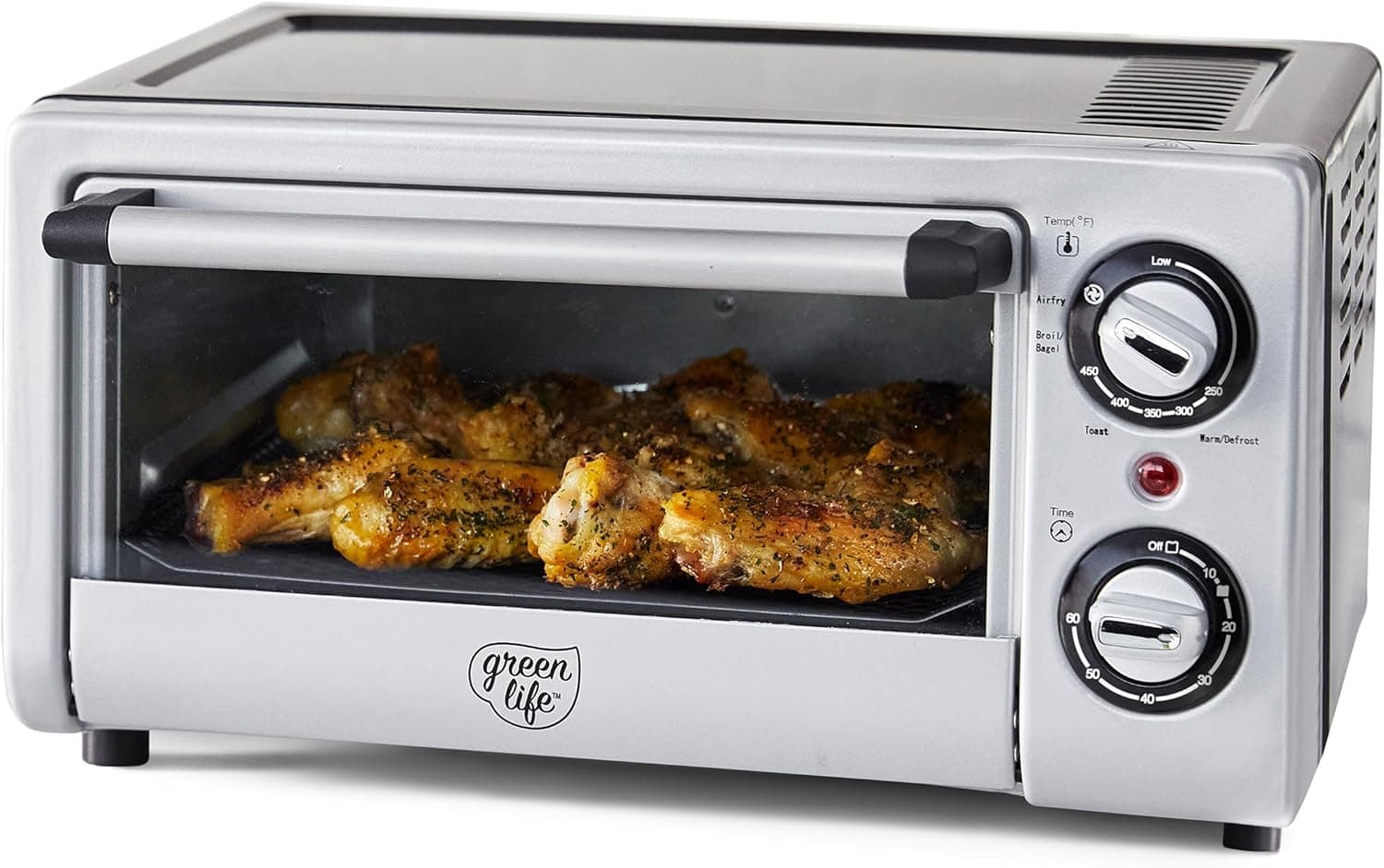
You want a simple, dial-control oven with no digital features to learn or maintain.
Counter space is tight and you need the smallest footprint that still fits a 9-inch pizza.
You prioritize cooking performance and capacity over material safety, and you primarily cook non-acidic foods.
You need a large countertop oven with air fry and dehydrate capability at a budget-friendly price.
You already own lined bakeware and plan to avoid using the included aluminum tray for acidic dishes.
You're equipping a rental kitchen or a space where premium material safety is not the primary criterion.
The main thing to know
The oven's interior cavity has a zinc coating that independent safety researchers have flagged for potential lead contamination at high temperatures. BLACK+DECKER makes no chemical-safety claims for any surface.
The interior coating type is completely undisclosed — Oster says 'non-stick' but won't specify whether it's PTFE, ceramic, or something else — and there's no PFAS-free claim anywhere. The bare aluminum baking tray adds a separate food-contact concern for acidic cooking.
Skip this if you...
Material safety across every surface matters to your family — the zinc-coated interior is an unresolved concern and the brand offers no chemical-safety assurances.
You want a brand that's transparent about what its products are made of — BLACK+DECKER doesn't publish interior material specs.
You need more than basic toast, bake, and broil — there's no reheat mode, air fry, or modern cooking presets.
You have young children and want confidence that the surfaces your food touches are free of unknown coatings or chemical concerns.
You want any level of PFAS-free assurance — Oster makes no such claim on this product.
You cook acidic foods regularly and plan to use the included baking tray.
You're comparing options and want the best safety-per-dollar at this price point — safer alternatives exist.
Neither of these quite what you're looking for?
I've reviewed all Toaster Ovens options at every price pointEvery Toaster Ovens in our database is scored using R3's deterministic scoring system - the same inputs always produce the same score. For this comparison, we evaluated BLACK+DECKER and Oster across 3 independent criteria: Safety (86%), Efficacy (6%), Usability (3%). No sponsored rankings. No paid placements.
Straight answers - no sponsored content, no filler.
I'd start with BLACK+DECKER BLACK+DECKER 4-Slice Toaster Oven - it scored 4.3/10 overall in our scoring system. Safety is our top-weighted scoring pillar, followed by efficacy, and usability. Check which pillar matters most to your family and compare those specific scores.
R3 uses a deterministic scoring system - the same inputs always produce the same score. We evaluate each Toaster Ovens across Safety, Efficacy, Usability using independently verified data. No sponsored rankings. No paid placements. Every score is fully reproducible.
Not necessarily. The overall score reflects our weighted rubric, but your priorities may differ. If you care most about safety, compare the safety scores directly. If budget drives your decision, the prices tell a clearer story. The "right" pick is the one that matches what matters most to your family.
Not the right match? Explore these alternatives in the same category.