Compare Stainless Steel Pans
Which scores higher on safety? R3 breaks it down.
The most important dimensions, side by side.
All-Clad D5 uses 18/10 stainless throughout — openly disclosed and consistent with premium stainless cookware standards. Safe for the general population; buyers with confirmed nickel sensitivity should note that 18/10 contains nickel.
Caraway uses 18/10 stainless steel on the cooking surface — the same grade as All-Clad and Heritage Steel. Buyers with nickel sensitivity should be aware that 18/10 contains nickel, though leaching stabilizes after a few weeks of regular use.
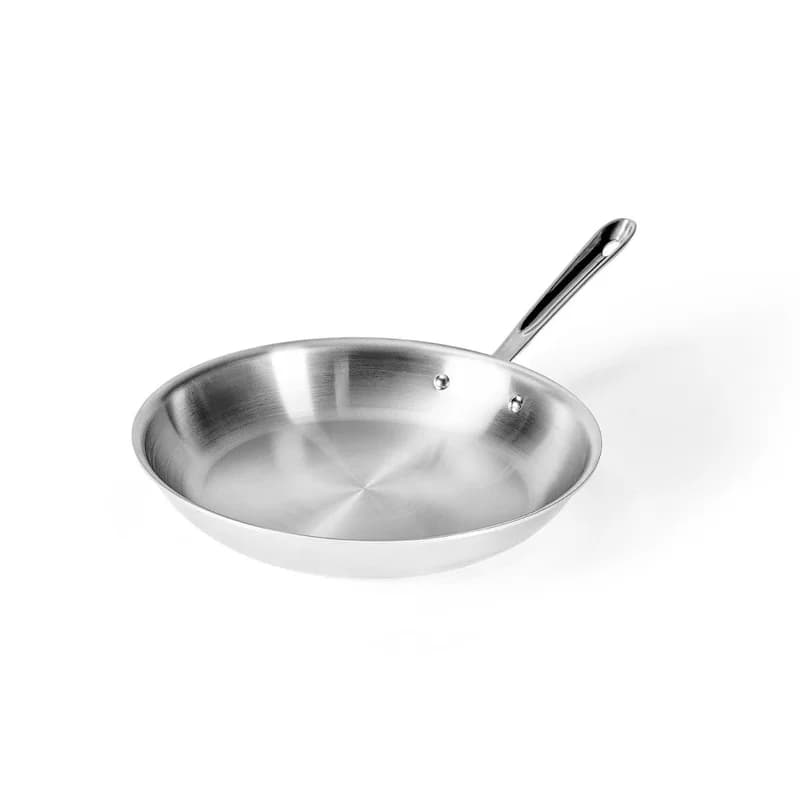
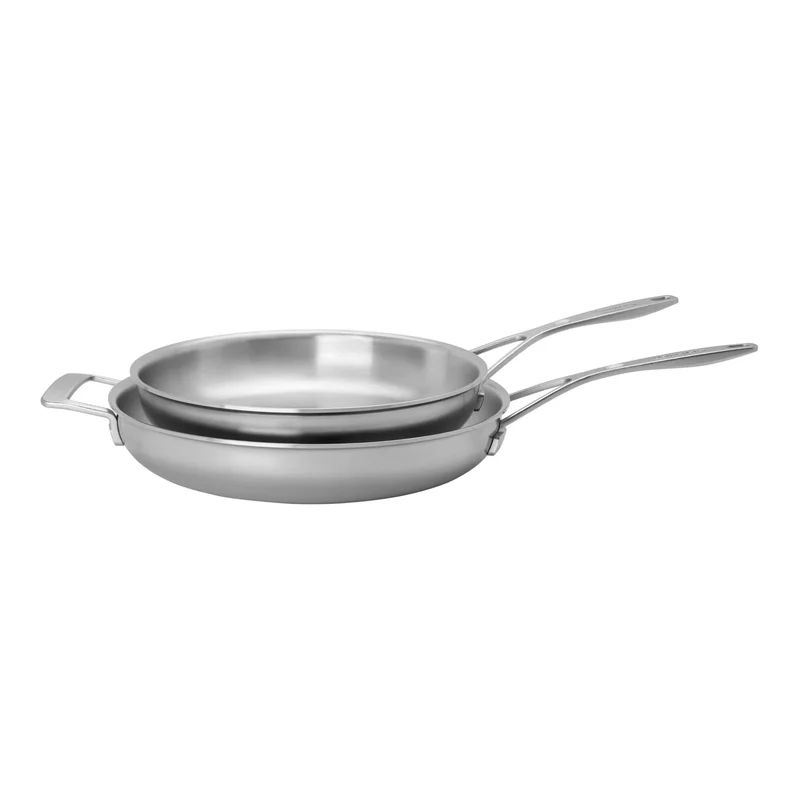
All-Clad's patented D5 bonding uses five layers all the way to the rim — the gold standard for even heat distribution. Alternating stainless and aluminum layers also reduce warping over time compared to standard tri-ply.
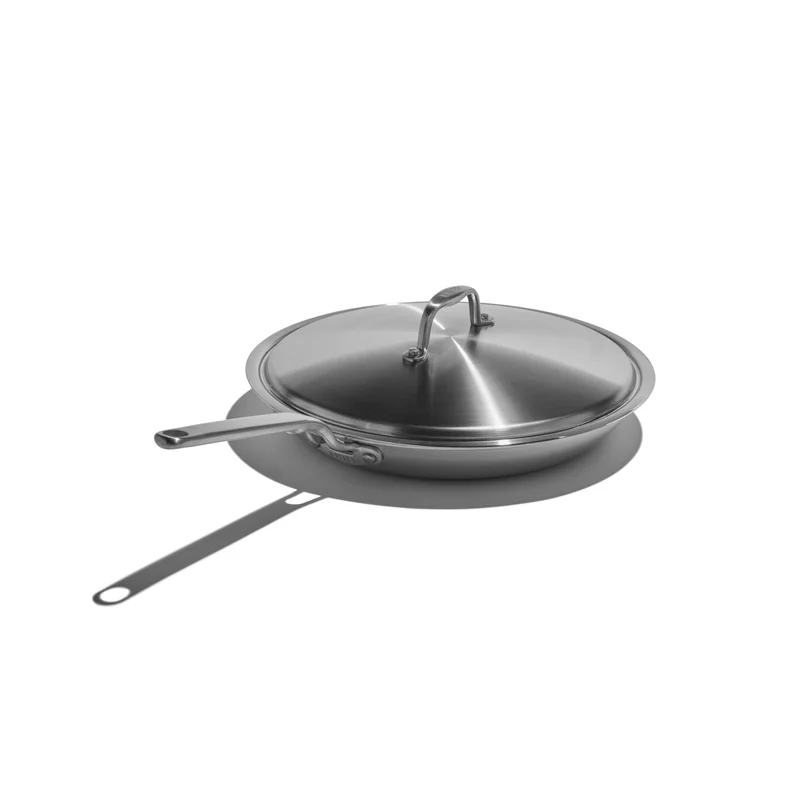
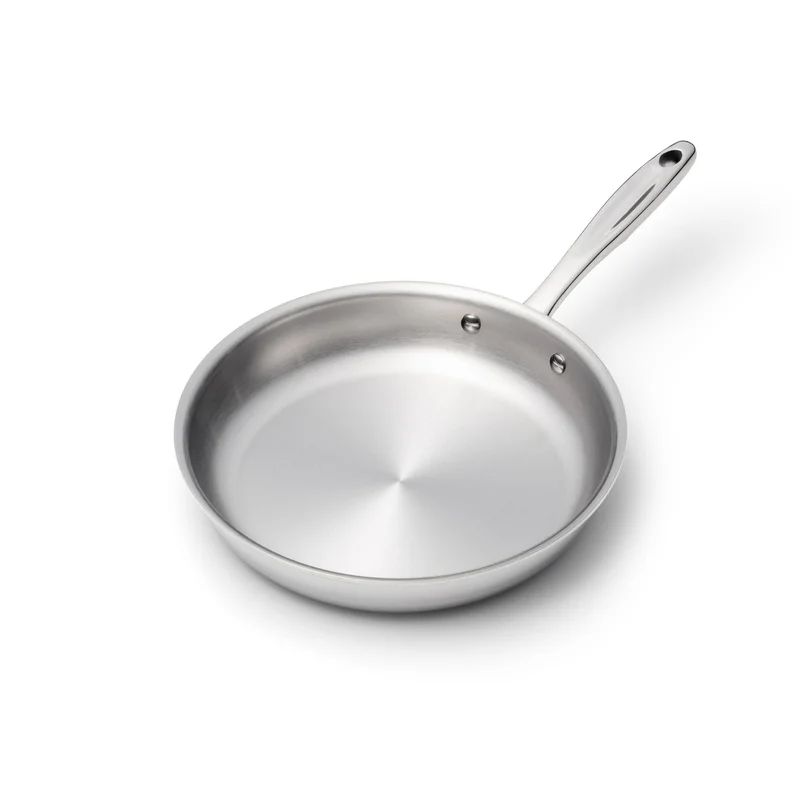
Five layers of bonded metal give the Caraway even, responsive heat across the full cooking surface — not just the base. This is the same construction standard recommended by independent safety researchers as the benchmark for stainless cookware.
All-Clad's bonding runs to the rim — no cold spots at the sidewalls, no hot spots on the base. This is what separates clad pans from cheaper disk-bottom designs and why they perform so consistently across heat sources.
Fully-clad means the aluminum core extends up the sides of the pan — food touching the sidewalls gets the same even heat as food on the base. This matters most when searing proteins or reducing sauces that climb the sides.
600°F is the second-highest oven rating in this category — enough for high-heat broiling and restaurant-style finishing. The only pan that goes higher is Heritage Steel at 800°F.
Oven safe to 550°F covers virtually all home cooking: roasting, baking, and standard broiling up to 450°F. If you regularly finish dishes under a high broiler or cook at 600°F+, Heritage Steel or All-Clad D5 give more headroom.
The D5 12-inch weighs 4.0 lbs — noticeable in daily use. Oven transfers and one-handed maneuvering require more effort than lighter alternatives. A real consideration if you cook frequently or have wrist concerns.
At 2.58 lbs, the Caraway 10.5-inch hits the sweet spot for daily use — light enough for one-handed flipping and oven transfers, heavy enough to feel substantial on the stove. One of the lightest 5-ply pans in this comparison.
The D5 at $200 is the most expensive pan in this comparison. You're paying for the All-Clad brand and the dual alternating-layer construction — though Heritage Steel delivers comparable safety scores at $150 with a better oven rating.
At $135, Caraway sits in the premium tier alongside Heritage Steel and All-Clad — a fair price for 5-ply fully-clad construction with steel grade transparency.
Everything you need to make the call - who each one is for, and who should skip it.
Go for it if you...
You want an All-Clad and the dual-layer alternating construction that reduces warping over time
You need 600°F oven capability for restaurant-style high-heat finishing
Weight is less important to you than the brand or long-term durability reputation
You cook on induction and want All-Clad's proven induction performance
You want a lightweight 5-ply stainless pan under 2.7 lbs for daily one-handed cooking
You like the Caraway brand's clean aesthetic and are already using their cookware ecosystem
Your stovetop-to-oven workflow stays below 550°F
Nickel transparency matters to you and you want a brand that discloses their steel grade
The main thing to know
At 4.0 lbs, the D5 12-inch exceeds ATK's comfort ceiling — daily one-handed maneuvering and oven transfers are noticeably more laborious than lighter alternatives like Heritage Steel (2.9 lbs).
The 550°F oven rating is the lowest among 5-ply competitors — if you finish dishes under a high broiler regularly, All-Clad D5 (600°F) or Heritage Steel (800°F) give more headroom.
Skip this if you...
You cook frequently with one-handed transfers or have wrist/strength considerations
You want the best overall specs for the money — Heritage Steel beats it on oven temp and weight at $50 less
You frequently finish dishes under a high broiler or cook at 600°F+ in the oven
You need steel grade confirmed from a brand spec table — not an editorial source
Neither of these quite what you're looking for?
I've reviewed all Stainless Steel Pans options at every price pointEvery Stainless Steel Pans in our database is scored using R3's deterministic scoring system - the same inputs always produce the same score. For this comparison, we evaluated All-Clad and Caraway across 3 independent criteria: Safety (54%), Efficacy (44%), Usability (2%). No sponsored rankings. No paid placements.
Straight answers - no sponsored content, no filler.
Both scored close to 8.7/10, so the better choice depends on your priorities. Safety is our top-weighted scoring pillar, followed by efficacy, and usability. Check which pillar matters most to your family and compare those specific scores.
R3 uses a deterministic scoring system - the same inputs always produce the same score. We evaluate each Stainless Steel Pans across Safety, Efficacy, Usability using independently verified data. No sponsored rankings. No paid placements. Every score is fully reproducible.
Not necessarily. The overall score reflects our weighted rubric, but your priorities may differ. If you care most about safety, compare the safety scores directly. If budget drives your decision, the prices tell a clearer story. The "right" pick is the one that matches what matters most to your family.
Not the right match? Explore these alternatives in the same category.